
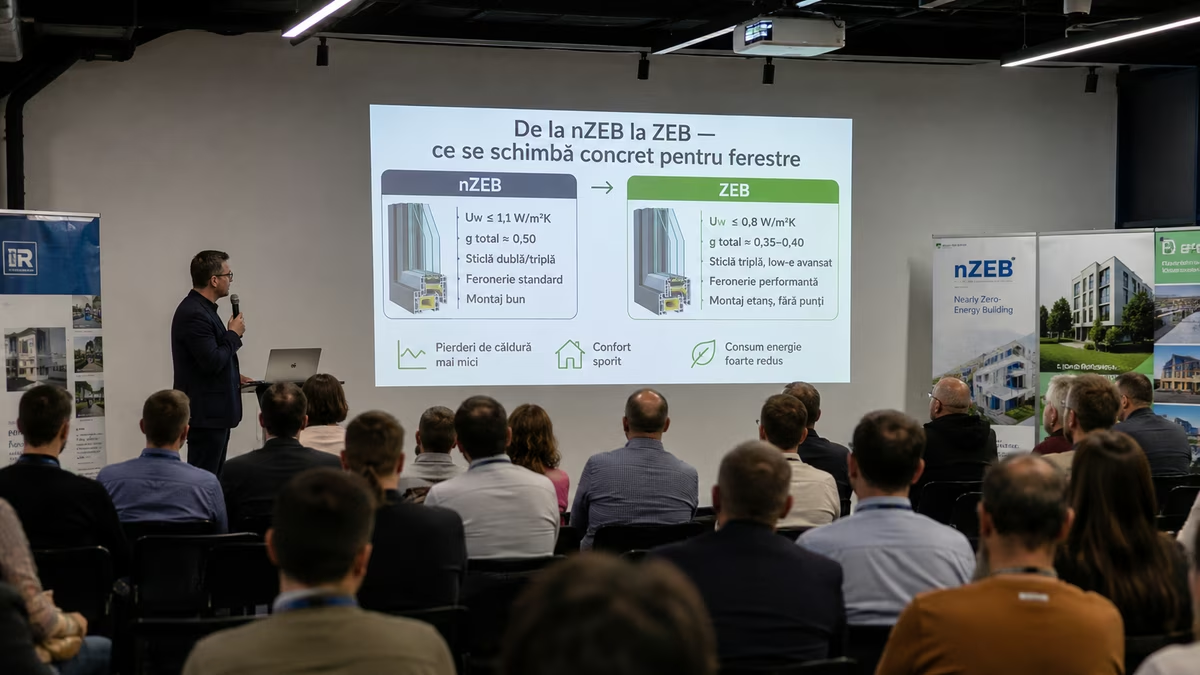

The European standard moves from “nearly zero energy” to “zero emissions”. For windows that means tighter Uw thresholds, real attention to the solar factor and installation that counts in the performance calculation.
For a decade, nZEB has been the benchmark for an efficient building in Romania. From 2030, the benchmark changes: every new building in the European Union will have to be a ZEB — a zero-emission building. The EPBD (EU 2024/1275) entered into force in May 2024, and member states had until 29 May 2026 to transpose it into national law. For anyone building or replacing windows right now, the practical question is simple: what actually changes at the window?
nZEB and ZEB do not measure the same thing
The difference is not just a numerical threshold. nZEB means “nearly zero energy consumption” — it looks at how much the building consumes. ZEB adds a second dimension: emissions. A zero-emission building has very low consumption and covers the remainder from renewable sources, with no fossil fuels burned on site.
For large buildings, the EPBD also introduces reporting of global warming potential across the whole life cycle — from material production to demolition. A window no longer counts only for how well it insulates, but also for how it was produced and what happens to it at the end.
The actual timeline
- 1 January 2028 — new public buildings must be ZEB
- 1 January 2030 — all new buildings must be ZEB
- 29 May 2026 — deadline for transposition into national law
Existing buildings are not required to become ZEB. For them, the directive sets renovation trajectories and targets for reducing the average consumption of the building stock.
What changes at the window: the Uw coefficient
Exact values are set by national transposition, but the direction is clear. As a practical benchmark, already used in serious nZEB projects:
| Parameter | nZEB (current benchmark) | ZEB (direction) |
|---|---|---|
| Window Uw | ≤ 1.1 W/m²K | ≤ 0.8 W/m²K |
| Solar factor g | ≈ 0.50 | ≈ 0.35–0.40 |
| Glazing | double or triple | triple, advanced low-E |
| Installation | properly executed | airtight, no thermal bridges |
The gap between 1.1 and 0.8 W/m²K looks small on paper. In practice it means a different class of product: triple glazing becomes mandatory, a warm edge spacer replaces the aluminium one, and the profile needs more chambers and greater structural depth. A 70 mm profile with double glazing will not reach 0.8 no matter how well it is installed. How to read this figure is explained in the guide on what thermal coefficient windows should have.
The solar factor g — the part almost everyone ignores
Uw describes heat loss in winter. The solar factor g describes how much of the sun’s energy passes through the glass in summer. The higher the g, the more heat comes in.
Under nZEB, a g of roughly 0.50 was acceptable because the focus was on heating. Under ZEB, where energy used for cooling is also counted, a high g becomes a problem: the building overheats in summer and spends on air conditioning exactly what it saved in winter.
Two practical consequences follow. First, solar control glass is no longer a luxury option but a calculation component. Second, external shading enters the equation as a design element rather than an accessory added later — because it stops radiation before it passes through the glass.
Installation enters the calculation, not just the product
This is the least discussed change and the most expensive one when ignored. A window with a Uw of 0.8 installed with nothing but polyurethane foam will not deliver the performance on its data sheet. Thermal bridges around the opening and air infiltration degrade the real result far beyond what the theoretical calculation suggests.
Installation across three sealing planes — vapour barrier inside, thermal insulation in the middle, vapour-permeable barrier towards the outside — becomes a performance requirement rather than a recommendation. Thermally insulating precasings move the frame out of the cold zone of the wall and eliminate the bridge at the lintel and the sill. The details are in the guide on perimeter insulation options.
What it means if you are replacing windows now
If you are renovating an existing house, you are under no obligation to reach ZEB. But there is a practical calculation to make: a window installed in 2026 stays on the house for 25–30 years, well past 2030.
Three decisions that matter:
- Do not drop below the current nZEB level. A 70–76 mm profile with triple glazing and a warm edge spacer will still be valid ten years from now.
- Ask for the solar factor, not just Uw. On south and west facades, an uncontrolled g means the air conditioning runs from May onwards.
- Do not cut costs on installation. The price difference between ordinary and airtight installation is a fraction of the joinery cost, but it decides whether the product reaches its rated performance.
For new builds permitted after 2028 the discussion is different: the design has to start from ZEB requirements, and the joinery is specified at that level from the outset. The comparison between materials in this context is covered in PVC or aluminium for nZEB homes.
FAQ — moving from nZEB to ZEB
What does ZEB mean for a building?
A ZEB (Zero Emission Building) has very low energy consumption, covered from renewable sources, with no direct carbon emissions from fossil fuels on site. Unlike nZEB, which measures consumption only, ZEB also includes the emissions dimension and, for large buildings, the global warming potential across the life cycle.
From what year does the ZEB standard become mandatory?
New public buildings must meet the standard from 1 January 2028, and all new buildings from 1 January 2030. The deadline for transposing the EPBD into national law was 29 May 2026.
Do I have to turn my existing house into a ZEB?
No. The ZEB obligation applies to new buildings. For the existing stock, the directive sets renovation trajectories and targets for reducing average consumption, not an individual obligation to comply with ZEB.
What Uw does a window need for ZEB?
Mandatory values are set by national transposition. As a practical design benchmark, the usual nZEB level is Uw ≤ 1.1 W/m²K, while the direction for ZEB is Uw ≤ 0.8 W/m²K, which requires triple glazing, a warm edge spacer and a profile with substantial structural depth.
Why does the solar factor matter under the ZEB standard?
Because ZEB also counts the energy used for cooling. A high solar factor lets a lot of heat in during summer, and the building spends on air conditioning the energy it saved on heating. ZEB aims for a g of roughly 0.35–0.40, combined with external shading.
Neofort BIZ supplies and installs Salamander PVC and Alumil aluminium joinery in Bucharest and Ilfov, with three-plane sealed installation and Blaugelb thermally insulating precasings. If you are preparing a project that has to meet nZEB or ZEB requirements, send us the project details and you will receive a quote within 48 hours. See also the complete nZEB systems or the guide on which windows to choose for an nZEB house.
Complete technical guide for nZEB windows in Romania 2026: mandatory minimum values, recom…
Read →nZEB SystemsComplete nZEB System: Salamander bluEvolution 92 + Blaugelb Triotherm+ Preframes + Triple Glazing — Full Technical Guide 2026What does an nZEB window system really mean? Complete technical guide: how Salamander bluE…
Read →nZEB SystemsWhat Are the Perimeter Insulation Options for Windows in Romania? Complete Guide 2026Window perimeter insulation is the most neglected component of a quality installation. Com…
Read →