
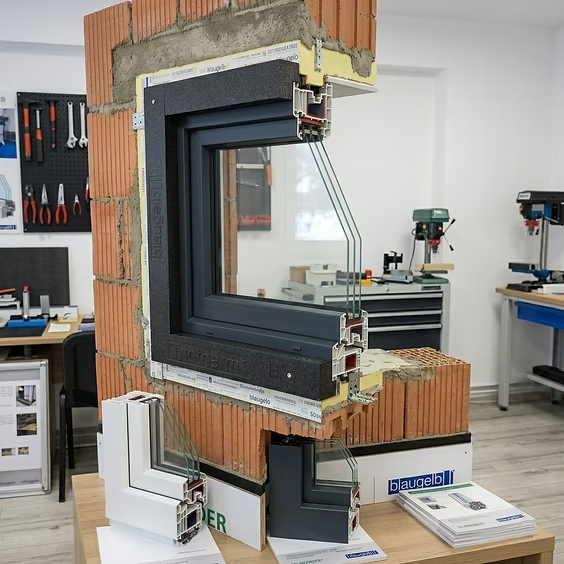

What does an nZEB window system really mean? Complete technical guide: how Salamander bluEvolution 92 profile combines with Blaugelb Triotherm+ preframes, Saint-Gobain triple glazing and pre-compressed bands to achieve Uw ≤ 0.8 W/(m²K).
What the nZEB standard is and why it matters for your windows
nZEB — Nearly Zero Energy Building — is not a brand or an optional certification. It is the mandatory standard for every new build in Romania from 2021, under Directive 2010/31/EU on the energy performance of buildings (EPBD) and its transposition through Law 372/2005 as amended.
In concrete terms, an nZEB building has to reach a primary energy consumption of ≤ 100 kWh/m²/year. Windows contribute directly to that balance — they represent on average 15–25% of the envelope surface of a dwelling and are responsible for 25–35% of the heat losses in a conventional building.
An nZEB window system does not simply mean a good profile. It means an integrated system in which every component is selected and installed to minimise heat loss at the window opening — from the profile itself to the insulating glass unit, the spacer inside the glazing package and the sealing of the perimeter against the masonry.
Component 1 — The Salamander bluEvolution 92 profile
Salamander bluEvolution 92 is the reference profile for nZEB construction in the Neofort BIZ portfolio. The technical characteristics relevant to the energy balance:
Profile geometry:
- 6 air chambers (5 main chambers plus 1 central reinforcement chamber)
- Structural depth: 92 mm
- Outer wall thickness: 3.0 mm (Class A to EN 12608)
- 3 perimeter EPDM gaskets
Thermal performance:
- Profile heat transfer coefficient: Uf = 0.95 W/(m²K) (value certified by IFT Rosenheim)
- Air tightness class: Class 4 (EN 12207) — the maximum possible
- Water tightness class: Class E1500 (EN 12208)
- Wind resistance: Class C5 (EN 12210)
Chemical composition:
- Stabilisers: exclusively calcium-zinc (Ca-Zn) since 2008 — no lead, no cadmium
- VinylPlus certified for recyclability
- Declared compliant with REACH Regulation (EC) No 1907/2006
Hardware included as standard:
- Roto NT or equivalent — adjustment on 3 axes
- RC2 burglary resistance available as an option
Component 2 — The Saint-Gobain SGG triple insulating glass unit
The glazing package is the component with the greatest impact on the Ug coefficient (heat transfer through the glass). The specification for the nZEB system:
Package structure: 4 mm float / 16 mm argon / 4 mm Low-E float / 16 mm argon / 4 mm float — 44 mm in total
Technical parameters:
- Ug = 0.5 W/(m²K) with argon at 90% concentration
- Ug = 0.6 W/(m²K) with argon at 80% concentration (standard)
- Solar factor g = 0.34 (Low-E on face 2)
- Light transmittance TL = 70%
- Acoustic attenuation Rw = 34–36 dB
The Warm Edge spacer:
The standard aluminium spacer has a thermal conductivity of λ = 160 W/mK — it creates a thermal bridge visible as a line of condensation on the inner edge of the glass during the cold season. The Warm Edge spacer (TGI, Swisspacer, Thermix) has λ = 0.15–0.2 W/mK — it reduces the thermal bridge by 75–85% and eliminates edge condensation.
Calculating Uw for the complete window (100 × 120 cm):
| Component | Value | Share |
|---|---|---|
| Uf (profile) | 0.95 W/(m²K) | about 30% of the area |
| Ug (triple glazing with argon) | 0.5 W/(m²K) | about 65% of the area |
| Ψg (Warm Edge spacer) | 0.030 W/mK | perimeter |
| Resulting Uw | 0.72 W/(m²K) | — |
Against the Uw = 1.4 W/(m²K) of a standard window with double glazing, the reduction in heat loss through the window is 49%.
Component 3 — Blaugelb Triotherm+ precasings
The Blaugelb Triotherm+ precasing solves the problem that no high-performance profile can solve on its own: the thermal bridge at the window perimeter — the contact zone between the frame and the masonry.
Why the perimeter thermal bridge arises:
The window frame, however well the profile performs, comes into direct contact with the masonry — a material with a thermal conductivity significantly higher than the air in the profile chambers. At an outside temperature of −15 °C, the temperature of the inner surface of the frame where it meets the masonry falls below the dew point → condensation → mould.
How the Blaugelb precasing works:
The precasing is installed before the window itself, in the plane of the wall’s thermal insulation. The composite material of the precasing has a thermal conductivity of λ = 0.035 W/mK — comparable to mineral wool. The window is then fitted onto the precasing, which:
- Thermally insulates the frame-to-masonry contact
- Allows the window to be installed within the plane of the insulation (a Passive House requirement)
- Creates a level, standardised mounting surface, independent of the quality of the masonry
The performance of the Triotherm+ precasing:
- PassivHaus Institut (PHI) certification for use in passive houses
- Eliminates the linear thermal bridge ψ (psi) at the window perimeter: from ψ = 0.08 W/mK (without precasing) to ψ = 0.01 W/mK (with precasing)
- Improvement in effective Uw: −0.05 to −0.12 W/(m²K) against installing directly into the masonry
Component 4 — Sealing the perimeter (pre-compressed tape)
The RAL guideline for professional window installation defines 3 sealing zones:
The outer zone: pre-compressed butyl tape (Illbruck TP600, blaugelb TrioSDL) — resistant to water (≥ 600 Pa), to UV and to temperature variation. It is applied to the window profile before installation and expands once fitted. Durability: 20–25 years.
The middle zone: semi-open cell polyurethane foam — provides the thermal and acoustic insulation of the space between frame and masonry.
The inner zone: vapour barrier film or tape — prevents the migration of vapour from inside into the joint, removing the risk of interstitial condensation and mould within the wall structure.
The economics: what it costs and what you save
Indicative cost of a complete nZEB system (100 × 120 cm window, installation included):
| Component | Indicative cost |
|---|---|
| Salamander bluEvolution 92 profile | 1,100–1,400 lei |
| Triple glazing with Warm Edge | included in the profile price |
| Blaugelb Triotherm+ precasing | 250–350 lei each |
| Professional installation with pre-compressed tapes | 300–450 lei |
| Total, 100 × 120 cm nZEB window | 1,650–2,200 lei |
Against a standard window (double glazing, no precasing): 900–1,200 lei
Annual energy saving (calculation for an 80 sqm apartment, 10 windows):
- Standard windows: estimated heat loss 2,800 kWh/year
- Complete nZEB windows: estimated heat loss 980 kWh/year
- Difference: −1,820 kWh/year → a saving of roughly 550–700 lei/year at current energy prices
Payback on the additional investment (a difference of about 7,000 lei for 10 windows): 10–13 years.
Beyond the financial payback, the nZEB system markedly improves thermal comfort (no cold zones beside the windows, no condensation), reduces noise and keeps the property in line with the energy regulations in force.
The nZEB installation procedure, step by step
- Installing the Blaugelb precasing — on the wall structure, in the plane of the insulation
- Applying the pre-compressed tape around the perimeter of the window frame
- Fitting the frame onto the precasing — levelled on 3 axes with metal anchors
- Injecting the polyurethane foam into the middle zone
- Applying the vapour barrier film in the inner zone
- Inserting the glazing package and adjusting the Roto NT hardware
- External siliconing with neutral, UV-resistant silicone
- Fitting the window boards inside (PVC) and outside (aluminium with a drip edge)
The installation details with Blaugelb Triotherm+ precasings are covered step by step here: installing Blaugelb Triotherm+ precasings — why it is mandatory.
Neofort BIZ installs complete nZEB systems in Bucharest and Ilfov — Salamander bluEvolution 92 profile, Blaugelb Triotherm+ precasings, Saint-Gobain triple glazing, Illbruck pre-compressed tapes. Request a technical quotation. See the nZEB systems we offer.
Frequently asked questions
What does a complete nZEB window system mean, rather than just a good profile?
An nZEB system means every component selected together: the Salamander bluEvolution 92 profile (Uf 0.95 W/m²K), Saint-Gobain triple glazing (Ug 0.5–0.6), a Warm Edge spacer and a Blaugelb Triotherm+ precasing to seal the perimeter. A good profile without correct installation loses its performance.
What is the Blaugelb Triotherm+ precasing for?
The Blaugelb Triotherm+ precasing solves the thermal bridge at the window perimeter — the contact zone between frame and masonry, which no high-performance profile can solve on its own. It is installed in the plane of the wall insulation and costs 250–350 lei each.
What Ug does the Saint-Gobain triple glazing achieve for nZEB?
The 44 mm triple package (4 float / 16 argon / 4 Low-E / 16 argon / 4 float) reaches Ug = 0.5 W/(m²K) with 90% argon, or Ug = 0.6 with the standard 80% argon, and a solar factor of g = 0.34 with Low-E on face 2.
Does the Salamander bluEvolution 92 profile contain lead?
No. Salamander bluEvolution 92 has used calcium-zinc (Ca-Zn) stabilisers exclusively since 2008, with no lead and no cadmium. It is VinylPlus certified for recyclability and declared compliant with REACH Regulation (EC) No 1907/2006.
Neofort BIZ carries out complete nZEB installations with Blaugelb Triotherm+ precasings and triple glazing in Bucharest and Ilfov. Send us the project details and you will receive a quote within 48 hours. See the complete nZEB systems we offer.
Complete technical guide for nZEB windows in Romania 2026: mandatory minimum values, recom…
Read →nZEB SystemsWhat Are the Perimeter Insulation Options for Windows in Romania? Complete Guide 2026Window perimeter insulation is the most neglected component of a quality installation. Com…
Read →nZEB SystemsFrom nZEB to ZEB: what actually changes for windows under the EPBDThe European standard moves from “nearly zero energy” to “zero emissions”. For windows tha…
Read →