

Window perimeter insulation is the most neglected component of a quality installation. Complete guide: the difference between foam, pre-compressed band and Blaugelb preframes, real costs and what the nZEB standard requires in Romania 2026.
Why Perimeter Insulation Matters More Than the Window Profile
You can install the best Salamander bluEvolution 92 profile with triple glazing and Warm Edge spacer, but if the gap between frame and masonry isn't correctly sealed, you lose 30–50% of the window's thermal efficiency. Thermal imaging of buildings with recently replaced windows frequently shows warm streaks around frames — a clear sign that perimeter insulation was neglected.
In Romania, the nZEB (Nearly Zero Energy Building) standard — mandatory for new constructions since 2021 and major renovations — explicitly requires sealing in three zones: interior (vapour barrier), middle (thermal and acoustic insulation) and exterior (water and wind protection).
The 3 Main Perimeter Insulation Options
Option 1 — Polyurethane Foam (Standard Installation)
How it works: Foam is injected into the gap between frame and masonry, expands and fills the gap. Silicone sealant or plaster is applied at the exterior.
Advantages:
- Low cost — included in any standard quote
- Easy to apply — any installer uses it
- Completely fills irregular gaps
Serious disadvantages:
- Cracks in 3–5 years under UV and temperature variation
- Allows water infiltration after degradation
- Poor acoustic insulation coefficient
- Does not meet nZEB requirements — no vapour barrier properties
- Once cracked, allows vapour to migrate toward the wall structure → condensation → mould
Conclusion: Foam alone = standard installation, acceptable for simple renovations, inadequate for nZEB standards.
Option 2 — Pre-Compressed Band (Professional Installation)
How it works: The pre-compressed band (e.g. Illbruck TP600, blaugelb TrioSDL 600, Soudal Compriband) is a polyurethane foam impregnated, compressed and stored rolled. It is applied to the window frame before installation. After installation it expands gradually (hours–days) and seals the external perimeter.
The 3 functions of the pre-compressed band:
- Exterior — waterproofing, resists driving rain (tested ≥ 600 Pa) and UV
- Middle — thermal and acoustic insulation
- Interior — vapour barrier (reduces vapour migration from interior toward gap)
Advantages:
- Meets nZEB requirements
- Superior durability vs silicone sealant (20+ years)
- Water and wind sealing without cracking
- Significantly better acoustic insulation than foam
- No additional exterior finishing work required
Disadvantages:
- Additional cost vs standard installation (10–20% of installation value)
- Requires correct application — band thickness must match gap width
Conclusion: Pre-compressed band = minimum standard for professional nZEB installation. Recommended for all new projects and energy-efficient renovations.
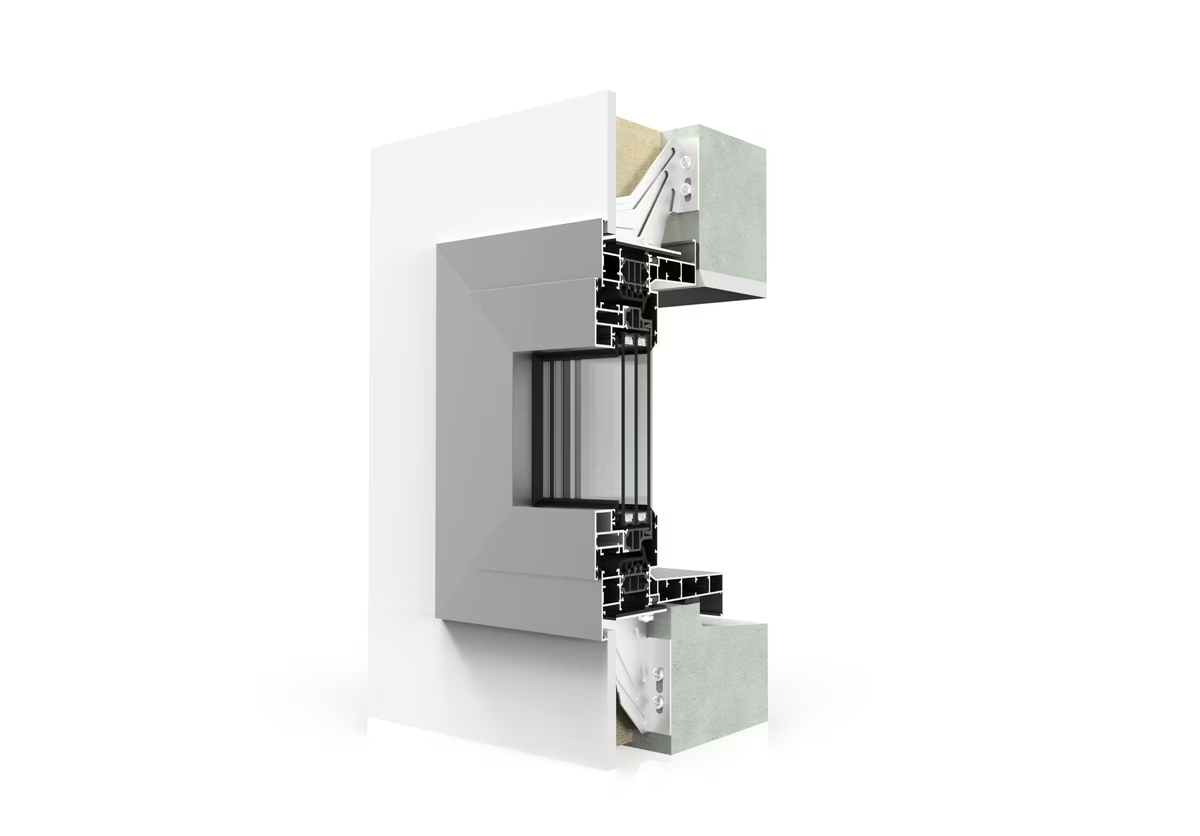
Option 3 — Blaugelb Triotherm+ Thermal Preframes (Premium nZEB Installation)
How it works: The Blaugelb Triotherm+ preframe is a thermal composite frame (thermal conductivity λ = 0.035 W/mK) that is mounted before the window, directly on the wall structure or in the thermal insulation plane. The window is subsequently mounted on the preframe, not directly in the masonry.
Key advantages:
- Completely eliminates the thermal bridge at the window perimeter — the frame no longer directly contacts the masonry
- Allows the window to be mounted in the thermal insulation plane of the wall (Passive House requirement)
- Makes future repair or replacement easier without affecting finishes
- Certified for nZEB and passive house constructions
When it's required:
- New constructions to nZEB or Passive House standard
- Renovations with complete thermal envelope refurbishment
- Thick insulation walls (where the window must be mounted outside the masonry)
Cost: €40–80/piece, depending on dimensions.
Direct Comparison — Which Should I Choose?
| Criterion | Standard foam | Pre-compressed band | Blaugelb preframe |
|---|---|---|---|
| nZEB compliance | ❌ No | ✅ Yes | ✅ Yes (premium) |
| Durability | 3–5 years | 20+ years | 30+ years |
| Acoustic insulation | Poor | Good | Very good |
| Vapour barrier | ❌ No | ✅ Partial | ✅ Complete |
| Relative cost | Included standard | +10–20% | +€40–80/piece |
| Recommendation | Simple renovation | Any new project | nZEB/Passive House |
What nZEB Requires in Romania
According to Law 372/2005 (amended) and GD 765/2016, any new building or major renovation must achieve primary energy consumption ≤ 100 kWh/m²/year. Windows must have Uw ≤ 1.0 W/(m²K) and installation must eliminate perimeter thermal bridges. In practice, polyurethane foam alone no longer meets these requirements — pre-compressed band or preframes are required.
Neofort BIZ installs with Illbruck pre-compressed bands and Blaugelb Triotherm+ preframes in Bucharest and Ilfov. Request nZEB installation quote. See the nZEB systems we offer.
Frequently Asked Questions
Why is perimeter insulation more important than the window profile?
You can fit the highest-performance profile with triple glazing and Warm Edge, but if the joint between frame and masonry is not sealed correctly you lose 30-50% of the thermal efficiency. Thermal images often show warm streaks around frames — a sign perimeter insulation was neglected.
What are the 3 options for window perimeter insulation?
Polyurethane foam (standard, cheap fitting, but cracks in 3-5 years and fails nZEB), pre-compressed tape (professional fitting, durable 20+ year seal) and the Blaugelb thermal pre-frame (the full nZEB standard, eliminating the perimeter thermal bridge).
Why is polyurethane foam not enough for the nZEB standard?
Foam alone cracks in 3-5 years under UV and thermal swings, allows water infiltration, has poor sound insulation and no vapour-barrier properties. Once cracked, it lets vapour migrate into the wall, causing condensation and mould — which is why it fails nZEB requirements.
What does the nZEB standard require for window fitting in Romania?
nZEB, mandatory for new builds since 2021 and major renovations, requires sealing in three zones: interior (vapour barrier), middle (thermal and sound insulation) and exterior (water and wind protection). Pre-compressed tape or a thermal pre-frame provides these layers.
Neofort BIZ carries out three-plane sealed installation with Blaugelb insulating precasings in Bucharest and Ilfov. Send us the opening details and you will receive a quote within 48 hours. See the complete nZEB systems we offer.
Complete technical guide for nZEB windows in Romania 2026: mandatory minimum values, recom…
Read →nZEB SystemsComplete nZEB System: Salamander bluEvolution 92 + Blaugelb Triotherm+ Preframes + Triple Glazing — Full Technical Guide 2026What does an nZEB window system really mean? Complete technical guide: how Salamander bluE…
Read →nZEB SystemsFrom nZEB to ZEB: what actually changes for windows under the EPBDThe European standard moves from “nearly zero energy” to “zero emissions”. For windows tha…
Read →