
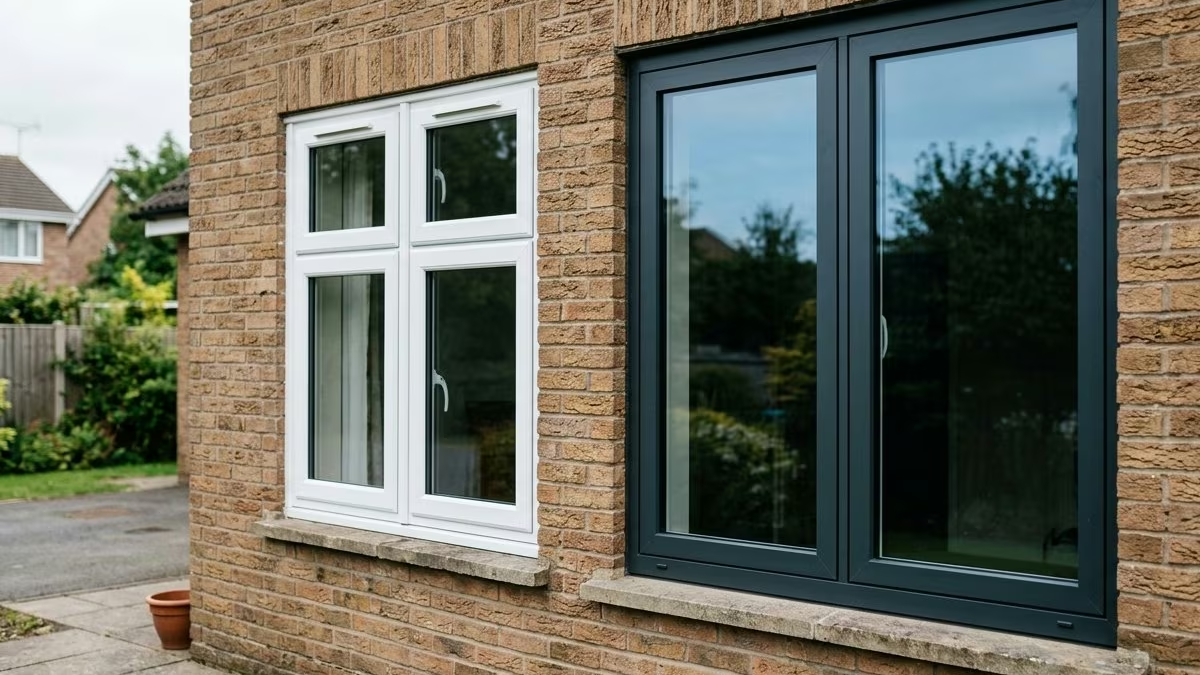

PVC or aluminium for your nZEB home? Complete technical guide 2026: real Uw, total cost, durability and usage scenarios. Clear answer for each situation.
What an nZEB house is and why the joinery choice matters
nZEB (Nearly Zero Energy Building) has been the mandatory standard for all new builds in Romania since 2021, under Government Decision 765/2016. An nZEB house has to reach a primary energy consumption of ≤ 100 kWh/m²/year.
Windows and doors make up 15-25% of the envelope surface and account for 25-40% of total heat losses. Choosing the wrong material — PVC or aluminium — can undo the entire energy balance of the house, even if the walls and roof are insulated perfectly.
Why does the PVC-versus-aluminium dilemma come up at all? Both materials have moved on considerably. Modern PVC is no longer "cheap plastic", and modern aluminium is no longer a "dangerous thermal conductor". The real difference lies in the use case.
Section 1 — The real differences between PVC and aluminium
Thermal insulation
PVC (Salamander bluEvolution 92):
- Profile thermal conductivity: λ = 0.17 W/(mK)
- Profile Uf = 0.95 W/(m²K)
- 6 chambers, 92 mm depth
- Total Uw with Saint-Gobain triple glazing + Warm Edge: 0.72 W/(m²K)
Aluminium (Alumil S77 Supreme):
- Pure profile conductivity: λ = 160 W/(mK) — brought down to about 0.3 W/(mK) by the 34 mm polyamide thermal break
- Profile Uf = 1.3 W/(m²K)
- Total Uw with triple glazing + Warm Edge: 1.0-1.2 W/(m²K)
Verdict on insulation: PVC wins clearly. A gap of 0.3-0.5 W/(m²K) in Uw means roughly 30% more heat lost through aluminium windows than through PVC ones at the same dimensions.
Structural strength and large glazed areas
Aluminium wins outright here, with structural strength three to four times that of PVC at the same section. The practical consequences:
- Large windows (over 1.5 m wide): aluminium allows visually slimmer profiles
- Large sliding units (3-6 m): aluminium is the standard solution
- Curtain walls: aluminium only
- Pivot windows: aluminium only
Design and appearance
Aluminium allows a much slimmer visible section — 30-45 mm against 60-80 mm for PVC — which means more glazed area, and any RAL colour including metallic or two-tone finishes. PVC offers the standard colour range and cannot be repainted after installation.
Service life and recyclability
| Material | Guaranteed life | Thermal deformation | Maintenance |
|---|---|---|---|
| Salamander PVC | 40+ years | Minimal | Annual (gaskets) |
| Alumil aluminium | 50+ years | None | Minimal |
Full comparison table: PVC vs aluminium for nZEB
| Characteristic | PVC Salamander bluEvolution 92 | Aluminium Alumil S77 Supreme |
|---|---|---|
| Uw with triple glazing (W/m²K) | 0.72 | 1.0-1.2 |
| Profile Uf (W/m²K) | 0.95 | 1.3 |
| Acoustic insulation Rw (dB) | 42-47 | 38-42 |
| Visible profile thickness | 70-82 mm | 30-45 mm |
| Large glazed areas | Limited | Excellent |
| Structural strength | Good (with reinforcement) | Superior |
| Service life | 40+ years | 50+ years |
| Relative cost | Lower | +20-35% |
| Recommended for nZEB | Ideal | Acceptable |
| Recommended for passive house | Ideal | Limited |
Section 2 — What actually matters in nZEB windows
The calculation formula for the thermal coefficient of a complete window:
Uw = (Ag × Ug + Af × Uf + lg × Ψg) / (Ag + Af)
The critical elements, in order of impact:
- Triple glazing with argon — Ug = 0.5 against 1.0 for double glazing: the single largest factor
- Warm Edge spacer — Ψg = 0.03 W/(mK) against 0.1 for aluminium spacers
- Profile type — Uf differs between PVC (0.95) and aluminium (1.3)
- Low-E coating — reduces the solar factor g and the emissivity
- Installation — pre-compressed tapes and elimination of the thermal bridge account for 30-50% of the total performance
Section 3 — When PVC is worth it and when aluminium is
Apartment renovation: Salamander PVC bluEvolution 82 or 92 — Uw = 0.72, saving 20-30% against aluminium
Premium villa: a mix — PVC for bedrooms and bathrooms, aluminium sliders for the living area
Passive house (PHI): Salamander PVC bluEvolution 92 with Blaugelb precasings — the only option below Uw 0.8 W/(m²K)
Commercial space, offices, facades: Alumil aluminium (curtain wall system, S77, SF85)
Large sliding units (over 3 m): Alumil Smartia M19800 aluminium
Section 4 — Common mistakes when choosing
❌ Choosing on chamber count alone — a 5-chamber profile with triple glazing can outperform a 7-chamber one with double glazing
❌ Ignoring the installation — without pre-compressed tapes and without eliminating the thermal bridge at the sill, you lose 30-50% of the performance
❌ Triple glazing with a standard aluminium spacer — without Warm Edge, Uw rises by 0.1-0.15 W/(m²K)
❌ Profiles without EN certification — Salamander profiles carry IFT Rosenheim certification and a CE declaration to EN 14351-1
❌ Aluminium for passive houses — standard aluminium (Uf = 1.3 W/m²K) cannot reach Uw ≤ 0.8 W/(m²K)
FAQ — PVC vs aluminium for nZEB
Which is more energy efficient: PVC or aluminium?
PVC, through the Salamander bluEvolution 92 — Uw = 0.72 against 1.0-1.2 for aluminium. The difference comes from thermal conductivity: PVC λ = 0.17 W/(mK) against pure aluminium λ = 160 W/(mK).
Does modern aluminium still cause condensation?
With a 34 mm thermal break, a Warm Edge spacer and correct installation, there is no condensation down to an outside temperature of −15 °C.
What Uw do you need for nZEB?
Romanian regulations (Government Decision 765/2016): Uw ≤ 1.0 W/(m²K) for climate Zone II, which covers Bucharest and Ilfov. PHI passive houses: Uw ≤ 0.8 W/(m²K).
Is triple glazing worth it over double?
Yes, always for nZEB. Ug = 0.5 against 1.0 halves the losses through the glass. The price difference of 15-25% pays for itself in 5-8 years.
Which profiles are recommended for passive houses?
Salamander bluEvolution 92 with 52 mm Saint-Gobain SGG triple glazing, a Warm Edge spacer and Blaugelb Triotherm+ precasings. Uw = 0.66-0.72 W/(m²K).
Which lasts longer: PVC or aluminium?
Aluminium — 50+ years against 40+ for PVC. Both outlast any untreated timber alternative.
What should I choose for large glazed areas?
Aluminium, without exception. Its structural strength is three to four times higher and it allows sliding units up to 6 m wide.
Conclusion — a clear recommendation by scenario
| Scenario | Recommended material | Main reason |
|---|---|---|
| Apartment renovation | PVC Salamander bluEvolution 82 | Optimal Uw, cost-effective |
| Standard new house | PVC Salamander bluEvolution 92 | nZEB with a safety margin |
| PHI passive house | PVC bluEvolution 92 + Blaugelb | The only option below Uw 0.8 |
| Villa with a large living area | Mix of PVC and aluminium sliders | Each material where it belongs |
| Offices, commercial | Aluminium Alumil S77 | Structure plus appearance |
| Curtain walls | Aluminium curtain wall system | Aluminium only |
The simple rule: maximum insulation → PVC. Design or large glazed areas → aluminium. Anything else → a mix.
Related: Complete nZEB System | nZEB Windows Guide Romania | Salamander Prices 2026
Neofort BIZ supplies Salamander (PVC) and Alumil (aluminium) in Bucharest and Ilfov. Request free consultation. Learn more about our Alumil systems we offer. For the full context, read the thermal break aluminium guide.
Is triple glazing worth it vs classic double? Concrete calculations for apartments and hou…
Read →Technical GuideHow Can I Improve Window Thermal Insulation in Bucharest? Complete Guide 2026Feeling heat loss through your windows in Bucharest? Complete guide 2026: how to improve t…
Read →Technical GuideThe PVC Toxicity Myth: Origins, What Science Says and Why Modern Windows Are Safe — Analysis 2026The toxic PVC myth is one of the most persistent in the construction industry. But where d…
Read →