
The most common question about Zipscreen blinds: blackout or transparent? Complete guide 2026 — real technical differences between 0%, 1–3% and 5–10% openness, what matters for your Bucharest terrace, how house orientation influences the choice, and what to order if you want both privacy and natural light.
The question we are asked most often: blackout or transparent?
Almost every client ordering a Zipscreen blind in Bucharest asks the same thing: “Which is better — blackout or transparent?”
The right answer depends on three factors: the orientation of the window or terrace, the main purpose (shading, privacy or visual comfort) and the urban context (street, neighbours, private garden).
This guide explains exactly what each option means and how to choose correctly the first time.
Understanding the “openness factor” — what 1%, 3%, 5% and 10% mean
The openness factor represents the proportion of gaps in the screen fabric against the total surface. A lower percentage means a denser material, less light and less visibility.
| Fabric type | Openness | UV filtering | Visibility from inside | Visibility from outside (daytime) |
|---|---|---|---|---|
| Transparent | 5–10% | 90–95% | Excellent | Low (mirror effect) |
| Semi-opaque | 1–3% | 97–99% | Good to low | Very low |
| Opaque (blackout) | 0% | 100% | None | None |
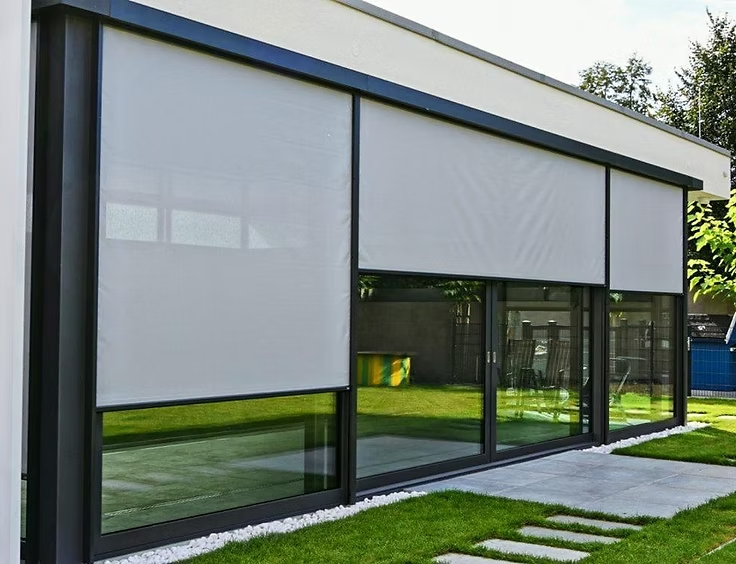
Beware of a common myth: with screen fabrics of 5–10% openness, you cannot see inside from the outside during the day — it works like a mirror. At night, with the interior lights on, the situation reverses.
The orientation of the house — the golden rule for choosing the fabric
South or west aspect (the warmest)
South and west facades receive the most direct sun — in summer, the interior temperature can rise by 8–15 °C without protection.
Recommendation: semi-opaque 1–3% or opaque 0% fabric.
- Reflects the maximum amount of solar radiation
- Choose light colours (white, pearl grey, cream beige) — they reflect more effectively than dark ones
- For a living room or office where you want visibility, 3% is the optimal compromise
East aspect (morning sun)
Strong sun in the morning (7–11), shade in the afternoon.
Recommendation: transparent 5% or semi-opaque 3% fabric.
- The morning sun is less aggressive thermally than the afternoon sun
- Visibility outwards is valuable if you have a view
North aspect (no direct sun)
Diffuse light, with no direct solar incidence.
Recommendation: transparent 5–10% fabric, or even an interior blind instead of a Zipscreen.
- The main issue is wind and rain, not heat
- Maximum visibility is an advantage
Terrace against window — different scenarios
Covered terrace (pergola, awning)
On a terrace, the Zipscreen replaces a wall — the aim is to create a usable outdoor room.
Recommended choice:
- North or east side: 5% transparent — lets the light in, blocks the wind
- South or west side: 1–3% semi-opaque — thermal protection plus privacy from neighbours
- Mixed solution: 3% on south and west, 5% on the other sides — the standard for terraces in Ilfov
Living room or bedroom window
On a window, the main aims are UV protection, privacy from the street or neighbours, and heat reduction.
Recommended choice:
- Living room with a view over a park or greenery: 5% transparent — you keep the view
- Bedroom on a busy street: 1–3% or 0% blackout — complete privacy
- Home office: 3% — reduces glare on the screen without losing the light
The colour of the fabric — not just an aesthetic matter
Colour directly influences thermal efficiency:
Light colours (white, light grey, beige, cream):
- Reflect 60–70% of the solar radiation
- Reduce the interior temperature more effectively in summer
- Recommended for south and west aspects
Dark colours (anthracite, black, dark brown):
- Absorb 60–70% of the radiation — they heat up more
- Give better visual contrast looking from inside outwards
- Recommended for north or east aspects, where heat is not the issue
The Neofort BIZ tip: for terraces in Bucharest, white or light grey on the south and west sides reduces the need for ventilation by 30–40% against anthracite.
Complete blackout (0%) — when it is the right solution
Total blackout makes sense in specific situations:
- ✅ A bedroom with an east or south aspect — sleep without morning light
- ✅ A cinema room or gaming space
- ✅ A relaxation pergola where you want complete privacy from neighbours
- ✅ A street-facing balcony with heavy traffic and neighbours opposite
- ✅ A showroom or shop with digital displays sensitive to sunlight
❌ Not recommended for: living rooms, kitchens, offices, or any space where natural light matters
Comparative prices by fabric type — 2026
> ⚠️ Note: the prices are indicative, valid as at March 2026. Ask for an up-to-date quotation.
| Fabric type | Openness | Indicative price per sqm installed |
|---|---|---|
| Standard transparent | 5% | 160–220 EUR/sqm |
| Semi-opaque | 3% | 170–240 EUR/sqm |
| Premium semi-opaque | 1% | 180–260 EUR/sqm |
| Complete blackout | 0% | 190–280 EUR/sqm |
*The price differences between types are small — the choice is made on technical criteria, not financial ones.*
A quick decision table
| Your situation | Recommended fabric |
|---|---|
| South or west terrace, you also want privacy | 1–3% in a light colour |
| East terrace, you have a fine view | 5% transparent |
| Bedroom on a busy street | 0% blackout |
| Living room with a large window onto the garden | 5% transparent |
| Home office, computer screen | 3% in a medium colour |
| Apartment balcony, neighbours opposite | 1–3% or 0% |
Free consultation — Neofort BIZ Bucharest
Not sure what to choose? Send us a photograph of the window or terrace along with the orientation of the house, and we will give you a specific recommendation.
WhatsApp: +40 752 443 435 | oferte@neofort-biz.ro | Mon–Fri 10–18
Frequently asked questions
Zipscreen blackout or transparent — which is better?
It depends on three factors: the orientation of the window or terrace, the main purpose (shading, privacy or visual comfort) and the urban context (street, neighbours, private garden). Transparent keeps the view and filters 90–95% of UV; blackout gives total darkness and 100% UV filtering, but no visibility at all.
What does the openness factor of a screen fabric mean?
The openness factor is the proportion of gaps in the fabric against the total surface. A lower percentage means a denser material, less light and less visibility. Transparent means 5–10% openness (90–95% UV filtered), semi-opaque 1–3%, opaque or blackout 0% (100% UV).
Can people see inside through a transparent screen during the day?
No. With screen fabrics of 5–10% openness, you cannot see inside from the outside during the day — the fabric works like a mirror. At night, with the interior lights on, the situation reverses and the inside becomes visible. It is a common myth that transparent fabric gives visibility from outside during the day.
Which Zipscreen fabric should I choose for maximum privacy?
For maximum privacy choose blackout (opaque, 0% openness) — it gives total darkness, no visibility in either direction and 100% UV filtering, ideal for bedrooms. If you also want to keep the view outwards, semi-opaque (1–3%) offers a compromise with reduced visibility and 97–99% UV filtered.
Neofort BIZ installs ZipScreen systems with blackout and transparent screen fabrics in Bucharest and Ilfov, sized for each opening. Discover the shading solutions we offer or request a quote. Compare every option in the complete guide to exterior shading systems.
Complete technical guide for nZEB windows in Romania 2026: mandatory minimum values, recom…
Read →Technical GuideTriple vs Double Glazing: How Much Do You Really Save on Heating? Real Calculations 2026Is triple glazing worth it vs classic double? Concrete calculations for apartments and hou…
Read →Technical GuidePVC or Aluminium for nZEB Homes in 2026? Complete Guide by Energy Efficiency, Cost and DurabilityPVC or aluminium for your nZEB home? Complete technical guide 2026: real Uw, total cost, d…
Read →