

Is triple glazing worth it vs classic double? Concrete calculations for apartments and houses in Romania 2026. Real savings per m², amortisation table and situations where triple is NOT optimal.
Why Triple Glazing Has Become the nZEB Standard
Until 2018, double glazing was the industry norm. Today, for any construction that must achieve nZEB standards, triple glazing is the realistic minimum requirement. The reason is simple and mathematical: Ug (the glass thermal transmittance coefficient) is the most important parameter of a window — and triple glazing halves it compared to double.
Myths about thermopane vs triple glazing:
- *"Triple glazing is too heavy for windows"* — False: a 100×120 cm triple glazed window weighs ~8 kg more than double; Roto NT hardware handles this without problems
- *"Triple glazing does not let enough light through"* — False: light transmittance TL = 70% vs 76-78% for double — visually imperceptible difference
- *"Condensation disappears completely with triple glazing"* — Partly true: central condensation disappears; marginal condensation depends on the spacer (Warm Edge eliminates this too)
Section 1 — The Real Technical Difference
Glazing Pack Structure
Standard double (32 mm total):
4 mm glass / 24 mm argon chamber / 4 mm Low-E glass
- Ug = 1.0 W/(m²K) with argon
- Ug = 1.1 W/(m²K) with air
Triple with argon and Low-E (44 mm total — Neofort BIZ standard):
4 mm / 16 mm argon / 4 mm Low-E / 16 mm argon / 4 mm
- Ug = 0.5 W/(m²K) — 50% better than double
- With Warm Edge: effective Ug on complete window = 0.55-0.60 W/(m²K)
Premium triple (52 mm — passive house):
4 mm / 18 mm argon / 4 mm Low-E / 18 mm argon / 4 mm Low-E
- Ug = 0.4 W/(m²K)
Heat Loss Calculation
Basic formula:
Q = U × A × ΔT × t
where:
- Q = heat lost (kWh)
- U = window Uw (W/m²K)
- A = window area (m²)
- ΔT = indoor-outdoor temperature difference (°C)
- t = time (hours)
Concrete example — 100×120 cm window (1.2 m²), Bucharest:
- Average ΔT cold season: 22°C indoor − 2°C winter average = 20°C
- Cold season hours (Oct-Apr): ~3,500 hours
| Glass type | Uw | Heat lost (kWh/year) | Energy cost (€/year)* |
|---|---|---|---|
| Old single (timber) | 4.8 | 403 | ~48 € |
| Standard double | 1.4 | 118 | ~14 € |
| Modern double argon | 1.0 | 84 | ~10 € |
| Triple + argon | 0.72 | 60 | ~7 € |
| Premium triple | 0.55 | 46 | ~5.5 € |
*Energy price ~0.12 €/kWh (2026)
Saving triple vs modern double (per 1.2 m² window): 24 kWh/year = ~€3/year
Section 2 — How Much Do You Save Annually: Real Examples
50 m² Apartment, 6 Windows (7.2 m² Total)
| Current configuration | Replacement with triple | Saving/year | Payback |
|---|---|---|---|
| Old single glazing | New triple windows + installation | ~€380/year | 5-7 years |
| Old double (pre-2005) | New triple windows + installation | ~€104/year | 8-12 years |
| Modern double (2010-2020) | New triple windows + installation | ~€33/year | 15-20 years |
House 120 m², 12 Windows (14.4 m² Total)
| Current configuration | Saving/year | Payback |
|---|---|---|
| Old single glazing | ~€760/year | 5-7 years |
| Old double | ~€208/year | 8-12 years |
| Modern double | ~€66/year | 15-20 years |
Premium Passive House 150 m² (Triple 52 mm)
Compared to modern double: saving ~€104/year. Compared to standard 44 mm triple: additional saving ~€26/year.
Section 3 — Real Advantages of Triple Glazing Beyond Savings
Thermal comfort
Interior glass surface temperature with triple at -5°C outside: +18°C (vs +12°C for double). Practical effect: you can sit next to the window in winter without feeling cold radiant draught.
Acoustic insulation — the pleasant surprise
Triple glazing (3 panes) has acoustic attenuation Rw = 34-36 dB versus 28-32 dB for double. A 6-8 dB difference means we perceive noise ~40% less loudly. Essential in Bucharest for apartments on busy roads.
Condensation reduction
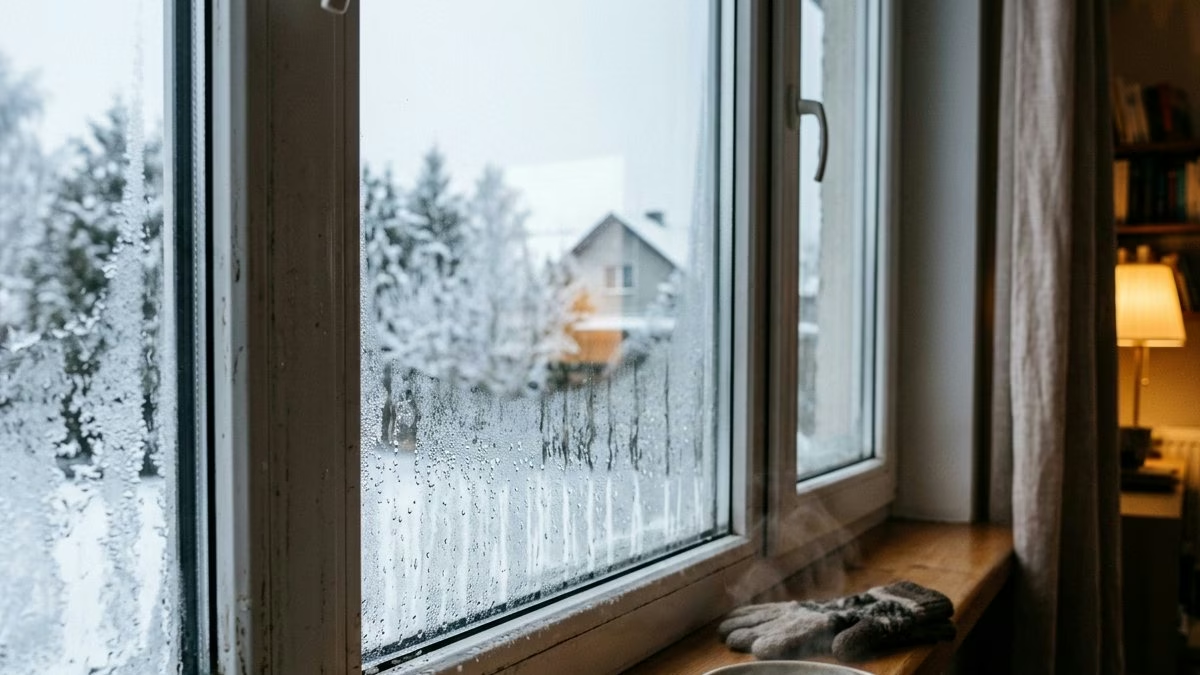
Dew point temperature at indoor (22°C, 50% relative humidity): 11°C. With triple glazing, the interior glass surface stays at +17-18°C → no condensation. With double, it can drop to 12-14°C → condensation possible at high humidity.
Solar factor and summer thermal comfort
Triple glazing with Low-E on position 2 (facing the middle chamber) has solar factor g = 0.32 versus g = 0.62 for standard double. Result: 48% less unwanted solar gain in summer → less AC consumption.
Section 4 — When Triple Glazing is NOT Worth It
Thermally uninsulated buildings
If walls, roof or floors are not insulated, windows represent less than 20% of losses. Investing in triple glazing is inefficient without envelope insulation.
Exclusively south-facing orientations with important solar factor
For houses designed with passive solar capture (south-facing with large windows), the low solar factor of triple glazing (g=0.32) can reduce useful solar gain in winter. Triple glazing with g=0.40-0.50 is recommended on the south facade.
Very limited budgets with functional existing windows
If current windows are modern double (Ug=1.0) in good condition, replacing them for savings of €33/year on a small apartment does not financially justify under 15 years. Alternative: replace gaskets and adjust hardware.
Historic buildings with architectural restrictions
The thicker triple glazing profile (44 mm vs 32 mm) may be incompatible with original joinery in listed buildings.
Full Comparison Table Double vs Triple
| Parameter | Standard double argon | Triple argon + Low-E | Premium triple |
|---|---|---|---|
| Ug (W/m²K) | 1.0 | 0.5 | 0.4 |
| Total thickness | 32 mm | 44 mm | 52 mm |
| Weight (1.2 m²) | ~16 kg | ~24 kg | ~28 kg |
| Acoustic attenuation Rw | 28-32 dB | 34-36 dB | 36-40 dB |
| Solar factor g | 0.62 | 0.32 | 0.28 |
| Interior condensation | Possible | Zero (with Warm Edge) | Zero |
| Premium vs double | — | +15-25% | +30-45% |
| Payback (apartment) | — | 8-15 years | 15-25 years |
FAQ — Triple vs Double Glazing
Does triple glazing reduce the energy bill?
Yes. Compared to modern double (Ug=1.0), triple (Ug=0.5) reduces heat loss through glass by 50%. On a 120 m² house, saving €66-208/year depending on what is being replaced.
What is the difference between thermopane and triple glazing?
Thermopane (double) has 2 glass panes and 1 gas chamber (argon or air). Triple has 3 panes and 2 argon chambers. Ug difference: 1.0 vs 0.5 W/(m²K) — 50% better.
Is the investment worth it?
Depends on current state. Against old single glazing: payback 5-7 years. Against old double (pre-2005): 8-12 years. Against functional modern double: 15-20 years.
Does triple glazing reduce noise?
Yes, significantly. Rw = 34-36 dB vs 28-32 dB for double. You perceive noise ~40% less loudly — a major difference for homes on busy roads.
What thickness is recommended?
44 mm (standard triple) for standard residential nZEB. 52 mm (premium triple) for PHI passive houses.
What gas is used between the panes?
Argon (90% concentration) — industry standard. Thermal conductivity λ = 0.018 W/(mK) vs λ = 0.026 for air. Krypton (λ=0.009) is superior but costs 3-4 times more.
What does Low-E glass mean?
Low-E (Low Emissivity) = glass with a thin metallic oxide layer deposited on the surface. Reflects infrared radiation (heat) back into the room in winter and blocks it in summer. Reduces Ug by 0.3-0.5 W/(m²K) compared to clear glass.
Conclusion — Simple Verdict
Triple glazing is worth it if:
- You are building or fully renovating (new windows anyway)
- You are replacing old single glazing or old double (pre-2005)
- You want maximum thermal comfort and good acoustic insulation
- You are building nZEB or a passive house
Triple glazing is not worth it if:
- You have functional modern double (Ug=1.0, gaskets OK)
- The building is not thermally insulated
- Limited budget and other more cost-effective energy efficiency priorities
Simple rule: If you are replacing windows anyway, choose triple — the price difference (15-25%) is guaranteed to recover. If current windows are functional, calculate the ROI for your specific situation.
Related articles:
- PVC or Aluminium for nZEB Homes in 2026?
- What Windows Should You Choose for an nZEB House in Romania?
- Where to Order Windows with Advanced Insulation in Bucharest?
Neofort BIZ installs Saint-Gobain SGG triple glazing with Warm Edge in Bucharest and Ilfov. Request a quote with personalised savings calculation. Discover the PVC windows range we offer.
PVC or aluminium for your nZEB home? Complete technical guide 2026: real Uw, total cost, d…
Read →Technical GuideHow Can I Improve Window Thermal Insulation in Bucharest? Complete Guide 2026Feeling heat loss through your windows in Bucharest? Complete guide 2026: how to improve t…
Read →Technical GuideThe PVC Toxicity Myth: Origins, What Science Says and Why Modern Windows Are Safe — Analysis 2026The toxic PVC myth is one of the most persistent in the construction industry. But where d…
Read →