

The toxic PVC myth is one of the most persistent in the construction industry. But where does it come from, what does chemistry actually say, and why do modern Salamander profiles have nothing to do with 1970s PVC? A documented analysis with real data.
Where the Myth Comes From — A Documented History
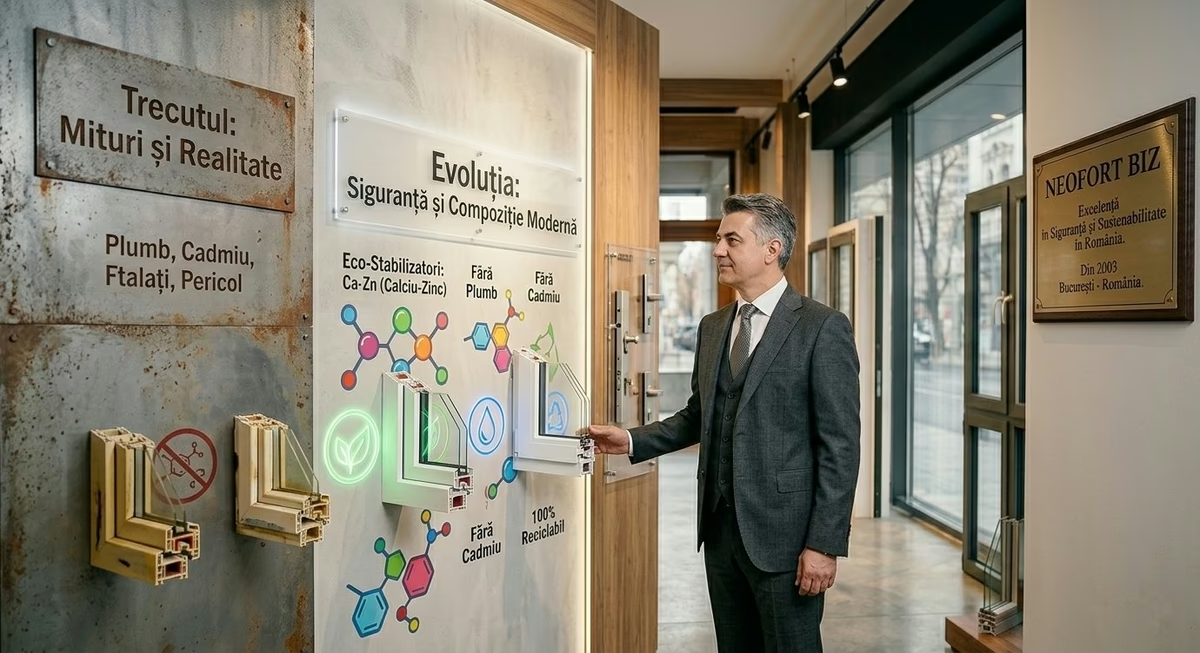
The PVC toxicity myth did not emerge from nowhere. It has real roots in the history of the chemical industry, but became frozen in the era when the problems were genuine, ignoring 40 years of technical progress.
In the 1940s–1970s, industrial PVC was stabilised with lead and cadmium compounds — heavy metals with proven toxicity. These substances prevented thermal degradation of the polymer during processing. Medical research in the 1970s and 1980s identified real risks: workers in PVC factories exposed to high temperatures without protective equipment showed elevated blood-lead concentrations.
Environmental organisations in Western Europe — particularly in Germany, Austria and the Netherlands — ran sustained campaigns against PVC throughout the 1980s and 1990s, based on data that was accurate for that period but predated the chemical modernisations already underway. The campaign was mediatively effective but created an image that no longer corresponded to the product being manufactured.
The problem is that the myth outlived the chemistry that generated it.
The Actual Chemical Composition of Modern PVC
PVC — polyvinyl chloride — is a synthetic polymer produced by polymerising vinyl chloride monomer (VCM). The composition of a modern PVC window profile includes:
- PVC resin: ~60-65% by mass. Chemically inert under normal use conditions, with no emissions below 60°C.
- Stabilisers: Until 2015, lead-based stabilisers were the European industry standard. The complete transition to calcium-zinc (Ca-Zn) stabilisers was completed through the voluntary Stabiliser 2015 programme coordinated by ECVM. Salamander profiles have used exclusively Ca-Zn stabilisers since 2008.
- Impact modifiers: Acrylic compounds improving shock resistance — non-toxic.
- Internal and external lubricants: Fatty acid esters or low molecular weight polyethylenes — biochemically inert.
- Pigments: Titanium dioxide (TiO₂) for white, or inorganic pigments for colours. TiO₂ is classified as safe by EFSA.
- Fillers: Calcium carbonate (CaCO₃) — the same material as eggshells and limestone.
What modern PVC profiles no longer contain: lead, cadmium, mercury or organotin compounds — all prohibited under REACH Regulation (EC) No 1907/2006.
Behaviour at Extreme Temperatures — Measurable Data
At normal use temperatures (−40°C to +60°C): PVC for windows is completely chemically stable. No detectable volatile substances. Salamander profiles are tested to EN 12608 for resistance to repeated thermal cycling across this range.
At elevated temperatures (60°C–140°C): The PVC profile begins to soften progressively — a reversible phase transition, not combustion. No toxic substances are emitted in significant quantities below the ignition point.
At ignition point (>270°C): PVC ignites less readily than wood (dry wood: ~220-260°C; PVC: >270°C). Once ignited, combustion gases include hydrogen chloride (HCl). According to the COWI study for the European Commission (2001), PVC's contribution to fire gas toxicity at residential scale is estimated below 5% of total toxic emissions.
At extreme cold (below −20°C): Window profiles are unplasticised (PVC-U). Salamander BluEvolution 92 is tested to EN 12608 at −20°C with no change to mechanical properties.
Why 1970s and Modern PVC Windows Are Fundamentally Different Products
1985–1995: European PVC industry voluntarily adopts ECVM programme to reduce lead and cadmium compounds.
1994: Germany bans cadmium stabilisers in PVC. The rest of the EU follows within two years.
2001: Voluntary ECVM/ESPA commitment to completely eliminate lead from PVC stabilisers by 2015 — achieved 5–7 years early.
2006: REACH Regulation classifies lead, cadmium and organotin compounds as Substances of Very High Concern (SVHC).
2008: Salamander completes full transition to Ca-Zn stabilisers across all profile ranges.
2015: European window PVC profile industry operates 100% without lead stabilisers. Confirmed through independent VinylPlus audit.
Recyclability: The Argument Anti-PVC Campaigns Ignore
PVC is one of the most recyclable construction materials. A PVC profile can be reprocessed up to 8 times without significant degradation of mechanical properties. The European industry recycles over 800,000 tonnes of PVC annually. VinylPlus data: between 2000 and 2023, 7.7 million tonnes of PVC were recycled across Europe.
What This Means Concretely for Your Home
Salamander BluEvolution 92 windows installed in 2026 contain no lead, cadmium, mercury or organotin compounds; emit zero VOCs at normal temperatures; are certified to EN 12608 and EN 14351-1 with Declaration of Performance under CPR 305/2011; carry a minimum 40-year manufacturer guarantee; and will be 100% recyclable at end of life.
The PVC toxicity myth played a useful role in pressuring the industry to eliminate genuinely problematic compounds. That pressure worked. The myth survived the transformations it triggered — making it today not a useful warning, but a technically unsupported prejudice.
Neofort BIZ supplies Salamander bluEvolution 92 profiles with REACH-certified Ca-Zn stabilisers. Request a quote. Discover the PVC windows range we offer. See also the Salamander bluEvolution 92 vs greenEvolution 76 comparison.
Frequently Asked Questions
Is the PVC in modern windows toxic?
No. Modern PVC window profiles are chemically stable at normal operating temperatures (−40°C to +60°C) and emit no detectable volatile substances. The toxicity myth dates from the 1940s-1970s, when PVC was stabilised with lead and cadmium — substances now banned under REACH.
What does a modern PVC window profile actually contain?
A modern PVC profile contains ~60-65% PVC resin (chemically inert), lead-free Calcium-Zinc stabilisers, non-toxic acrylic modifiers, titanium dioxide for colour and calcium carbonate — the same material as eggshell. It no longer contains lead, cadmium, mercury or organotin compounds.
What happens to PVC windows in a fire?
PVC ignites harder than wood (>270°C versus 220-260°C). According to the COWI study for the European Commission (2001), PVC joinery's contribution to fire-gas toxicity in a home is under 5% of the total — significantly less than synthetic carpet or melamine furniture.
Why are 1970s PVC windows different from today's?
They are chemically different products. Since 2008, Salamander uses exclusively Calcium-Zinc stabilisers, and the European industry has fully eliminated lead and cadmium through the ECVM programme and legal bans (Germany, 1994). The myth outlived the chemistry that created it.
Neofort BIZ supplies Salamander PVC joinery with lead-free calcium-zinc stabilisers in Bucharest and Ilfov. Ask us anything about the materials and you will get an answer within 48 hours. See the PVC joinery range we offer.
Is triple glazing worth it vs classic double? Concrete calculations for apartments and hou…
Read →Technical GuidePVC or Aluminium for nZEB Homes in 2026? Complete Guide by Energy Efficiency, Cost and DurabilityPVC or aluminium for your nZEB home? Complete technical guide 2026: real Uw, total cost, d…
Read →Technical GuideHow Can I Improve Window Thermal Insulation in Bucharest? Complete Guide 2026Feeling heat loss through your windows in Bucharest? Complete guide 2026: how to improve t…
Read →