
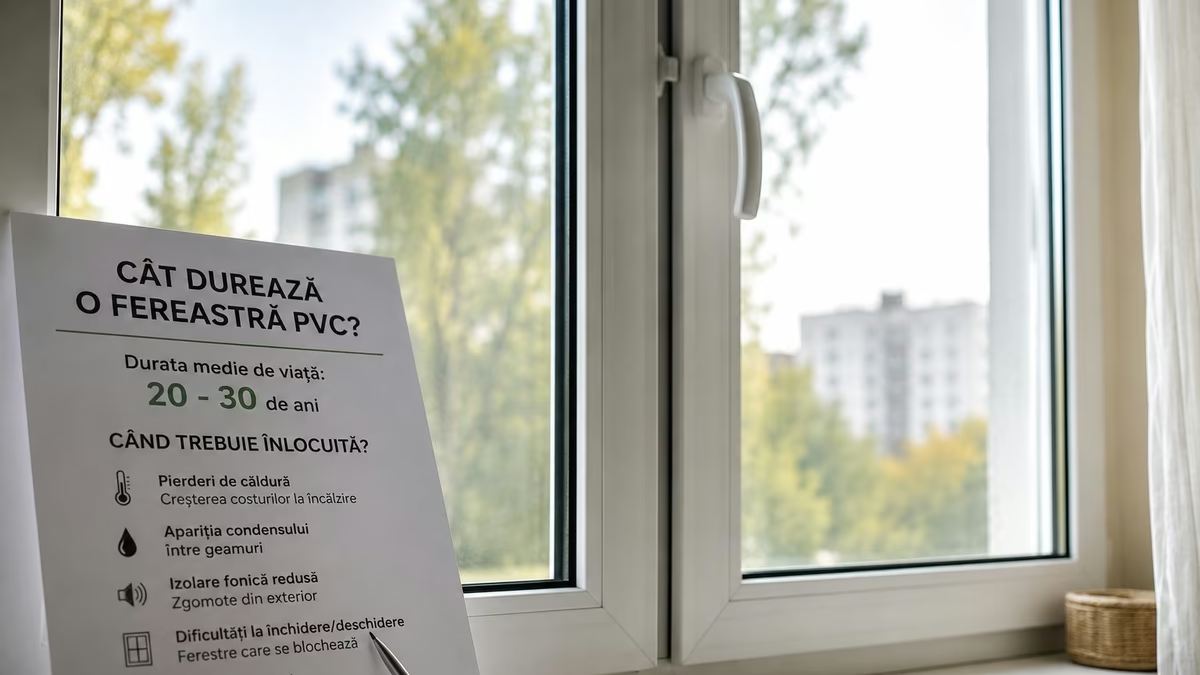

How long do modern PVC windows last and when is it time to replace them? Complete guide with real component lifespan, 7 clear wear signs, repair vs replacement profitability calculation and preventive maintenance tips.
How long does a PVC window last in normal conditions?
A modern PVC window, with certified profiles and professional installation, has a service life of 30–50 years under normal use. The hardware — hinges, locking gear, closing mechanisms — needs replacing after 15–20 years, but the profile and the glazing stay serviceable far longer.
Service lives guaranteed by Neofort BIZ:
- Salamander bluEvolution PVC profiles: 5-year warranty, estimated life 40–50 years
- Triple argon insulating glass: 5-year warranty on the seal, estimated life 30–40 years
- Roto/Winkhaus hardware: 2-year warranty, estimated life 15–25 years with maintenance
Why do some windows fail sooner?
| Factor | Impact on service life |
|---|---|
| Profile quality (chamber count, wall thickness) | Major — Class A profiles last twice as long |
| Installation quality (pre-compressed tapes, anchoring) | Major — poor installation leads to leaks and degradation |
| Regular maintenance (lubricating the hardware) | Medium — without lubrication the mechanisms fail in 8–10 years |
| UV exposure (orientation, no curtains) | Minor — modern profiles with UV stabilisers hold up |
| Climate (temperature extremes, humidity) | Minor for quality PVC profiles |
Seven clear signs a PVC window needs replacing
1. Permanent condensation between the panes
Condensation between the panes of the sealed unit — not on the inner surface of the glass — means the seal of the glazing unit has failed. The argon has escaped and the unit no longer insulates. This cannot be repaired; the unit has to be replaced.
2. Draughts or water ingress
If you feel a draught around the window when it is closed, the gaskets are worn. If water appears on the inner sill after rain, the perimeter seal has failed. Both call for prompt intervention.
3. Difficulty opening or closing
A window that jams, that will not close properly, or whose handle resists excessively has worn hardware or a deformed frame. If adjusting the three-point hardware does not solve it, replacement is required.
4. The profile is yellowed, brittle or cracked
Older profiles from before 2000, made with lead-based stabilisers, yellow and grow brittle over time. Cracks at the corners or on the profile surface indicate irreversible degradation of the material.
5. Heating costs have risen noticeably
A rise of 20–30% in energy bills that has no other explanation can point to a loss of thermal performance in the windows. A simple test: hold your hand 10 cm from the window in winter — if you feel intense radiant cold, the glazing no longer insulates.
6. Outside noise has increased
If the traffic has not changed but you hear it more clearly, the acoustic gaskets are worn. Modern triple glazing with Rw = 34–36 dB removes roughly 40% of perceived noise compared with old double glazing.
7. The gaskets are hard, cracked or missing pieces
EPDM gaskets wear and harden within 10–15 years. Once hard they no longer seal. They can be replaced on their own, but if the frame is worn as well, full replacement is the better value.
Repair or replace? The correct calculation
When repair is worth it
- Worn hardware on otherwise sound windows → replace the hardware alone (40–80 EUR per window)
- Worn gaskets → replace the gaskets (10–20 EUR per window)
- Broken glass or condensation inside the unit → replace the glazing unit alone (80–160 EUR)
- Windows under 15 years old with an intact profile → systematic repair
When full replacement pays better
- Yellowed or cracked profiles → these cannot be repaired
- Old double-glazed windows from before 2010 → switching to triple cuts the bill by 35–50%
- Uw above 1.5 W/(m²K) → replacement with triple glazing pays back in 8–12 years
- Windows with structural leaks → the frame itself has degraded
What does replacing PVC windows cost in 2026?
| Window type | Size | Indicative price (excluding installation) |
|---|---|---|
| Tilt-and-turn PVC Salamander bluEvolution 92, triple | 80×120 cm | 230–345 EUR |
| Tilt-and-turn PVC Salamander bluEvolution 92, triple | 100×150 cm | 360–540 EUR |
| Double PVC window bluEvolution 92, triple | 150×120 cm | 430–650 EUR |
| PVC balcony door, triple | 80×210 cm | 405–605 EUR |
Prices excluding VAT and installation, worked out from the per-square-metre prices of bluEvolution 92 with triple glazing; installation is added in the quote
Payback calculation for replacement:
A 50 m² apartment with 6 old double-glazed windows (Uw = 2.0), replaced with triple-glazed Salamander 92 (Uw = 0.72):
- Annual saving: around 100 EUR per year on energy (at 0.12 EUR/kWh)
- Total cost for 6 windows: around 1,700–2,600 EUR, excluding installation
- Payback: more than 20 years — but the thermal and acoustic comfort improve immediately
How to extend the life of PVC windows
Mandatory maintenance twice a year, in spring and autumn:
- Lubricate all hardware mechanisms with silicone oil, not WD-40
- Check and adjust the three-point hardware setting
- Clean the gaskets with soap and water, then apply silicone spray
- Check the perimeter seal — if you feel a draught, call for service
- Clean the profile with non-abrasive, non-acidic products
What not to do:
- Cleaning with acetone, thinner or abrasive products
- Painting the profile without PVC-specific products
- Fixing objects to the profile by drilling
- Forcing the handle while the window is open
FAQ — PVC window service life
How long do Salamander PVC windows last?
The Salamander PVC profile has an estimated service life of 40–50 years under normal conditions. The commercial warranty from Neofort BIZ is 5 years. The hardware needs replacing or servicing after 15–20 years.
Can the glazing be replaced without changing the frame?
Yes, if the frame and profile are in good condition. A new glazing unit costs 80–160 EUR against 230–345 EUR for a complete window. The installer checks whether the frame rebate allows a thicker unit, for instance triple instead of double.
How often should gaskets be replaced on PVC windows?
EPDM gaskets are replaced every 10–15 years. The signs: they feel cracked to the touch, they no longer spring back into shape, or a draught appears with the window closed.
Is it better to repair or replace old windows?
It depends on the condition of the profile and the current thermal performance. If the profile is intact and the present Uw is below 1.5 W/(m²K), repair is worthwhile. If the profile has degraded or Uw exceeds 1.5 W/(m²K) and you want energy efficiency, full replacement is better in the long run.
What does servicing PVC windows cost?
Hardware adjustment and lubrication: 30–50 EUR per window, or an annual service contract. Gasket replacement: 10–20 EUR per window. Complete hardware replacement: 80–140 EUR per window.
Related: Window Thermal Coefficient Guide 2026 · Triple vs Double Glazing Savings
Neofort BIZ installs Salamander PVC windows with 5-year warranty and service in Bucharest and Ilfov. Request quote or service. Learn more about the Salamander PVC systems we offer. Replacement without disturbing the plaster uses the PVC renovation frame; the price levels are at PVC joinery prices. Rules change too — see what changes for construction products in 2026.
The simplest airtightness test: with a sheet of paper you find out in 2 minutes exactly wh…
Read →Practical GuideHow to adjust Roto hardware for winter/summer mode with an Allen keyDraught or whistling at the window? Often it is solved with a Roto hardware adjustment, no…
Read →Practical GuideWhen window gaskets need replacing: 5 clear signsWindow lets air in and whistles even after adjustment? The gaskets are the cause. The 5 cl…
Read →