
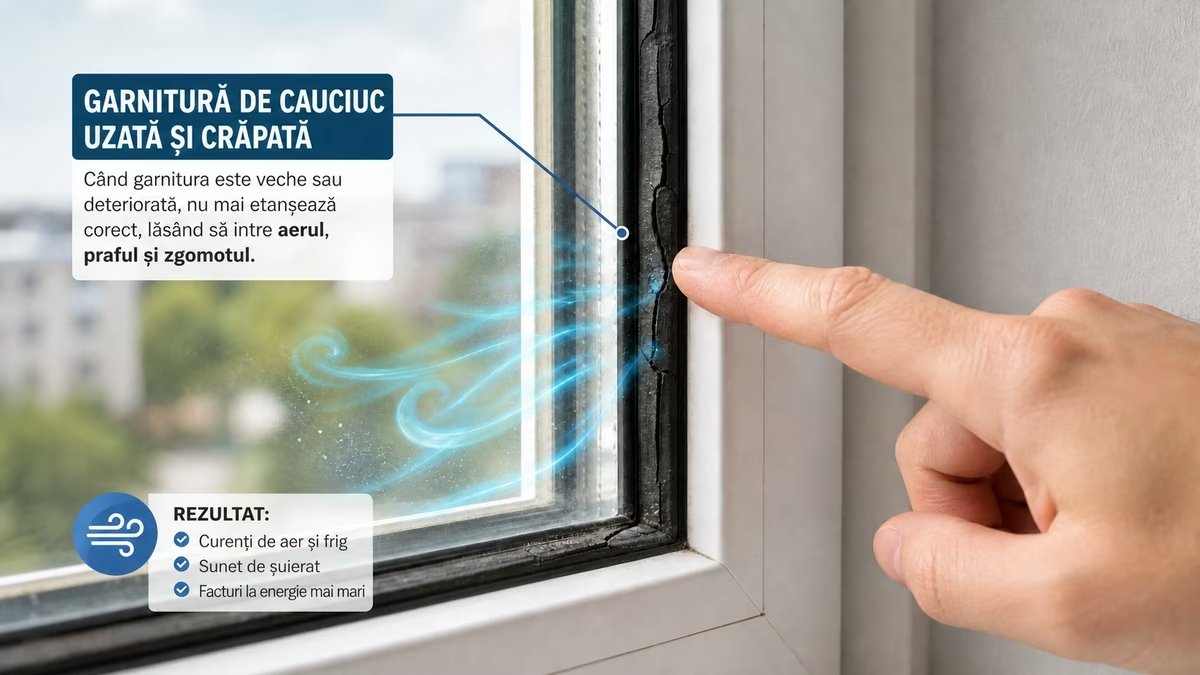

Window lets air in and whistles even after adjustment? The gaskets are the cause. The 5 clear signs they must be replaced — from hard, cracked rubber to condensation on the contour — and what the change involves.
You adjusted the hardware, you did the paper sheet test, but the window still lets air in and whistles in the wind? Then, most likely, the problem can no longer be adjusted — the gaskets have worn out and must be replaced. Gaskets are the part that degrades fastest on a window and, fortunately, they are also the cheapest to change. This guide shows you how to recognise a worn gasket, what the clear signs are that it must be replaced and what the replacement involves.
What gaskets actually are and why they wear out
Gaskets are the rubber or EPDM strips fitted around the contour of the sash and frame. Their role is to compress the space between the moving and fixed parts of the window when you close it, so that no air, water or noise gets through. A window usually has 2 or 3 rows of gaskets, on different levels, for better sealing.
The problem is that rubber, however good, ages. Under the action of sun, cold, heat and repeated compression at every opening, the material gradually loses its elasticity. On quality PVC windows, gaskets usually last 8–12 years; on cheap ones, much less. When the rubber no longer returns to shape after being compressed, micro-gaps appear through which air enters.
> The key sign: a good gasket is soft, flexible and elastic — you press it with your nail and it springs back. A worn gasket is hard, dry, sometimes cracked or permanently flattened. The difference is felt immediately to the touch.
Sign 1: The gasket is hard and cracked to the touch
The clearest sign. Open the window and run your finger over the gasket on the sash. If it is soft and rubbery — it is good. If it is hard as plastic, dry, with fine cracks or missing pieces, it has lost its elasticity. Such a gasket no longer seals, no matter how much you adjust the hardware.
Sign 2: You feel a cold draught with the window closed
With the window fully closed, run your hand over the inner contour. If you feel cold air entering — especially in wind — the gasket no longer compresses correctly. You can confirm exactly where with the paper sheet test: if the paper comes out easily even after you have adjusted the hardware to maximum, the gasket is the cause.
Sign 3: Whistling that does not disappear with adjustment
If you have already tried adjusting the Roto hardware and the whistling persists, it is a sign that the problem is no longer the pressure, but the gasket that can no longer be compressed enough. Adjustment increases the pressing, but if the material is hardened and flattened, it no longer moulds to the surface — and the air still gets through.
Sign 4: Condensation and damp on the window contour
A worn gasket lets cold air in exactly at the window edge, where it meets the warm air from the room. There, condensation appears and, over time, black mould on the glass contour. If you see condensation or localised black spots on the window edge (not in the middle of the glass), a weak gasket is often the cause.
Sign 5: Outside noise louder than before
Gaskets do not only stop air, but also noise. If you notice that, lately, you hear the street louder than you remember, it is possible the gaskets have worn out and no longer insulate against sound as well. It is a more subtle sign, but a real one.
What replacing the gaskets involves
The good news: it is one of the simplest and cheapest interventions on a window. The old gasket is pulled out of its channel (on most systems it is just pressed in, not glued), and the new one is pushed back into place. The key is to use the correct gasket for your profile system — Salamander, for example, has a specific gasket profile, and an unsuitable universal gasket will not seal correctly.
That is why, although the change itself seems simple, it is worth having it done by someone who has the right gasket for your profile and fits it without stretching it (if you stretch it during fitting, it will contract back and gaps will appear at the corners). The cost is small compared to the heat saving and the comfort regained.
Adjustment or new gaskets — how to decide
The simple rule: try adjustment first, move to gaskets if adjustment is not enough. If you want to understand from the start what the real cause of the draught or whistling is, start from the general guide Why windows whistle when the wind blows, which shows you all the possible causes and how to tell them apart.
FAQ — Replacing gaskets
How do I know if I need to replace my window gaskets?
The clearest sign: the gasket is hard, dry or cracked to the touch, instead of being soft and elastic. In addition, if you feel a draught with the window closed and the whistling does not disappear even after you adjust the hardware, the gasket is the cause and must be changed.
How long do PVC window gaskets last?
On quality windows, gaskets usually last 8–12 years. On cheap profiles or windows heavily exposed to sun and weather, they can dry out faster. It is not the glass or profile that fails first, but the gasket — that is why it is normal to replace it once or twice over the window's lifetime.
Can I change the gaskets myself?
Technically, the old gasket is pulled out and the new one is pushed into the channel, without special tools. The difficult part is getting the correct gasket for your profile (Salamander has a specific profile) and fitting it without stretching it, otherwise it contracts and leaves gaps at the corners. That is why many prefer to leave this to a specialist.
How much does replacing gaskets cost?
It is one of the cheapest interventions on a window, much less than a new window or even than a hardware repair. The exact cost depends on the length of gasket and the type of profile, but relative to the heat saved and the comfort regained, it pays off quickly.
Is it worth changing the gaskets or the whole window?
If the profile and glass are in good condition and only the gasket has worn out, changing the gasket is the obvious choice — you solve the problem at a fraction of the cost of a new window. The whole window is only justified if the profile is degraded, the glass is broken or the glazing is fogged between panes.
Neofort BIZ replaces gaskets and services Salamander PVC and Alumil aluminium joinery in Bucharest and Ilfov, with gaskets suited to each profile. If your windows let air in and adjustment no longer helps, request a free on-site assessment. Discover the PVC windows range we offer. Our supplied range includes pre-compressed joint sealing and the renovation profile.
How long do modern PVC windows last and when is it time to replace them? Complete guide wi…
Read →Practical GuideThe paper sheet test: find out yourself where the air entersThe simplest airtightness test: with a sheet of paper you find out in 2 minutes exactly wh…
Read →Practical GuideHow to adjust Roto hardware for winter/summer mode with an Allen keyDraught or whistling at the window? Often it is solved with a Roto hardware adjustment, no…
Read →