
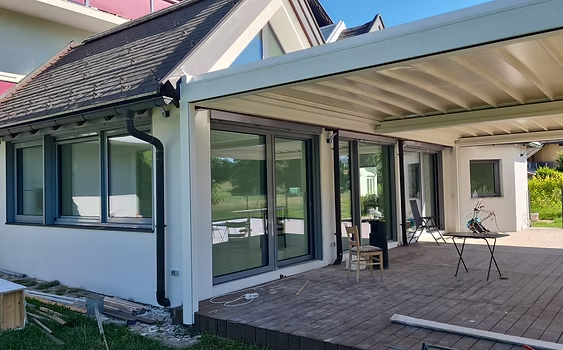

Completed Neofort BIZ project: Salamander BluEvolution 92 ALU aluminium clad exported for a mountain house in France. The PVC profile with aluminium exterior is the ideal choice for alpine climates — maximum protection against UV, frost, snow and extreme thermal variations, with PVC thermal performance and aluminium appearance.
The Neofort BIZ Project — Export to France, Mountain House
This project perfectly illustrates the intersection of export, extreme climate and maximum thermal performance. A Romanian client based in France, mountain house in the French alpine zone — clear requirements: aluminium appearance, PVC performance, resistance to severe climate.
The solution: Salamander BluEvolution 92 ALU, the PVC profile with exterior aluminium cladding.
What is BluEvolution 92 ALU aluminium clad?
BluEvolution 92 ALU is NOT an aluminium profile. It is a BluEvolution 92 PVC profile (6 chambers, 92 mm, nZEB performance) with an aluminium foil bonded to the exterior face of the profile.
| Feature | Standard PVC | Pure Aluminium | BluEvolution 92 ALU |
|---|---|---|---|
| Thermal insulation | ★★★★★ Excellent | ★★☆☆☆ Needs break | ★★★★★ Excellent |
| UV resistance exterior | ★★★☆☆ Good (10 yr) | ★★★★★ 25 yr | ★★★★★ 25 yr |
| Frost resistance | ★★★☆☆ Medium | ★★★★★ Excellent | ★★★★★ Excellent |
| Extreme thermal variation | ★★★☆☆ Small deform | ★★★★★ Stable | ★★★★★ Stable |
| Price vs pure aluminium | -40% | Reference | -20 to -30% |
Conclusion: for a mountain house with harsh winters, intense UV at altitude and 60–70°C thermal variations between summer and winter, BluEvolution 92 ALU is superior to both pure aluminium (better thermal insulation) and standard PVC (incomparably better exterior resistance).
Why alpine climate is hardest on windows
At 1,000–2,000 m altitude: thermal variation of 55°C (vs 35°C at sea level), UV intensity 25–30% higher, snow accumulation on sills, wind gusts exceeding 100–120 km/h. BluEvolution 92 ALU handles all these with the aluminium foil as primary barrier.
Indicative prices BluEvolution 92 ALU — 2026
> ⚠️ Important note: All prices are indicative and subject to market changes. Always request an updated quote.
| Configuration | Estimated price (installed) |
|---|---|
| Tilt-and-turn 100×120 cm, double Low-E | 480–640 EUR |
| Tilt-and-turn 100×120 cm, triple Low-E | 600–780 EUR |
| Price per m² installed | 280–400 EUR/m² |
*vs BluEvolution 92 standard: +15–20%. vs equivalent aluminium: -25–35%.*
We communicate in Romanian, English, French and German. We deliver across the EU — no customs duties, complete CE documentation.
WhatsApp: +40 752 443 435
Frequently Asked Questions
How is the aluminium-clad BluEvolution 92 ALU profile built?
It is not an aluminium profile, but a PVC BluEvolution 92 profile (6 chambers, 92 mm, nZEB performance) with aluminium foil bonded to its outer face. It combines PVC's excellent thermal insulation with aluminium's UV resistance and exterior durability (25 years).
Why is BluEvolution 92 ALU ideal for a mountain house?
For a mountain house with harsh winters, intense UV radiation at altitude and thermal swings of 60-70°C between summer and winter, BluEvolution 92 ALU is superior to both pure aluminium (better thermal insulation) and standard PVC (incomparably better exterior resistance).
What is the advantage of BluEvolution 92 ALU over pure aluminium?
BluEvolution 92 ALU offers the same UV, frost and extreme-thermal-swing resistance (25 years) as pure aluminium, but with excellent thermal insulation (PVC) instead of needing a thermal break. In addition, it costs 20-30% less than pure aluminium.
Is BluEvolution 92 ALU suitable for export to harsh climates?
Yes. It is the product designed exactly for the intersection of export, extreme climate and maximum thermal performance. The aluminium look with PVC performance makes it ideal for Romanian clients settled in France, Austria or alpine areas with harsh-climate resistance requirements.
Neofort BIZ manufactures and installs Salamander PVC joinery in Bucharest and Ilfov, with delivery across Europe. See Salamander PVC windows we offer or request a quote. All the details in the full joinery export context.
Complete technical guide for nZEB windows in Romania 2026: mandatory minimum values, recom…
Read →Technical GuideTriple vs Double Glazing: How Much Do You Really Save on Heating? Real Calculations 2026Is triple glazing worth it vs classic double? Concrete calculations for apartments and hou…
Read →Technical GuidePVC or Aluminium for nZEB Homes in 2026? Complete Guide by Energy Efficiency, Cost and DurabilityPVC or aluminium for your nZEB home? Complete technical guide 2026: real Uw, total cost, d…
Read →