
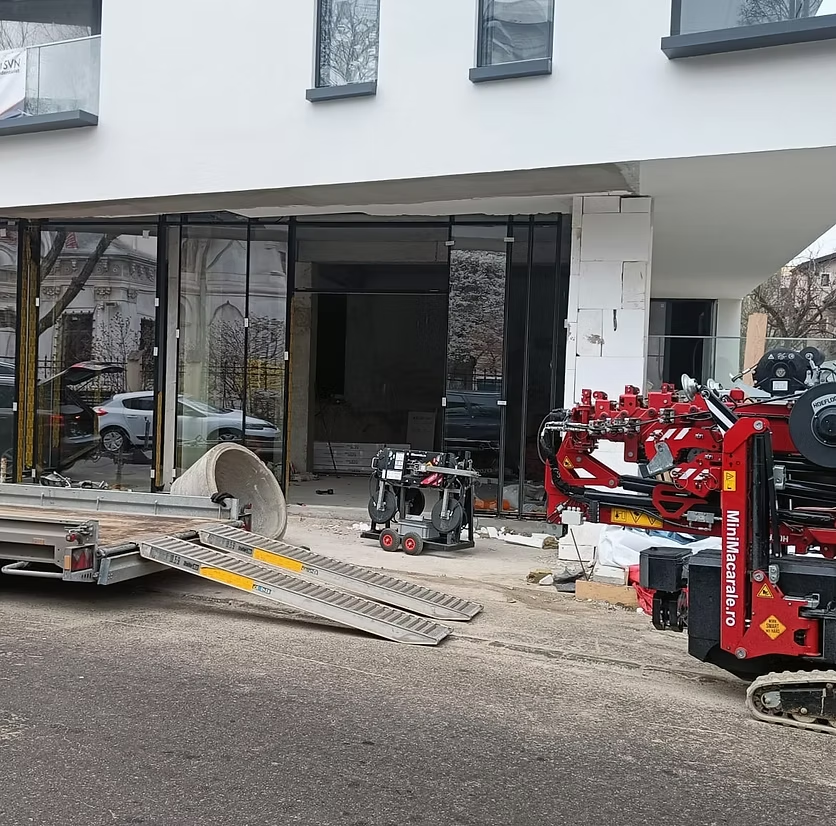

A 3×4 m tempered glass panel 12 mm thick weighs 360 kg — impossible to handle manually without major risk of breakage and accidents. The vacuum cup robot allows millimetre-precise positioning of panels up to 1,400 kg. Complete guide: how it works, what equipment we use and why it is the only safe installation method.
Why oversized glass cannot be installed by hand
A simple calculation explains everything:
- Toughened glass 10 mm → 25 kg/sqm
- A panel of 3,000 × 4,000 mm → 12 sqm × 25 kg = 300 kg
- The same panel in 12 mm → 360 kg
- A toughened insulating unit 6+16+6 at 3 × 5 m → 500+ kg
No team of installers can physically handle 300–500 kg of glass without:
- A major risk of breakage (toughened glass shatters on impact, it does not bend)
- A serious risk of injury (a 300 kg panel that falls or breaks is a lethal hazard)
- Being unable to position it to the accuracy required (errors of 2–3 mm destroy the seal)
The solution: the vacuum-cup robot — the only equipment that allows large glass panels to be handled safely and precisely.
How the vacuum-cup robot works
The operating principle
Vacuum cups create a zone of negative pressure (partial vacuum) on the surface of the glass. The resulting holding force is proportional to the area of the cup and to the level of vacuum:
The simplified formula: F = P × A
Where F is the holding force (kg), P is the pressure difference against atmosphere (bar) and A is the area of the cup (cm²).
An industrial cup of 200 mm diameter at 0.85 bar of vacuum generates a holding force of roughly 270 kg. Multi-cup systems reach a total capacity of 1,400 kg.
The TGT RoboCrane system — the equipment we use
TGT RoboCrane 1400 is the European reference system for the installation of oversized glass:
- Maximum capacity: 1,400 kg per panel
- Working height: up to 10 m
- Lateral reach: up to 7.5 m
- Positioning accuracy: ±1 mm by remote control
- Available movements: 360° rotation, forward and back tilt, lateral travel, telescoping
- Travel: tracks — it can move over any ground, including sand, gravel and small steps
- Control: wireless remote with overload protection and emergency stop
The dual vacuum system — certified safety
The robot uses two independent vacuum circuits to EN 13155:
- If one circuit fails, the other keeps the panel suspended
- Audible and visual alarm when the pressure falls below the safety threshold
- Vacuum hold time without electrical supply: at least 15 minutes (battery backup)
The steps of a professional oversized glass installation
Stage 1 — Site assessment (the day before)
We check: access for the truck carrying the glass, manoeuvring space for the tracked robot, clear height at the ceiling (if indoors) and the fixing structure for the glass (prepared and verified).
Stage 2 — Specialised transport
Oversized panels travel vertically, in special racks with foam separators. The truck dedicated to large glass has a lowered floor and systems to lock the racks in place.
Unloading: with the truck crane or with the robot — the panels never come to rest horizontally, because of the risk of breakage.
Stage 3 — Preparing the robot
- Calibrating the cups for the specific type of glass
- Vacuum test at 110% of the panel weight
- Positioning the robot at the optimal working distance
Stage 4 — Gripping the panel
The robot approaches the upright panel in its rack, the cups adhere to the surface and the vacuum system activates. Confirmation of the grip: a digital indicator displays the holding force in real time.
Stage 5 — Lifting and positioning
Using the remote control, the operator lifts the panel, rotates it if necessary (for example from vertical to horizontal for rooflights), moves it laterally and positions it to millimetre accuracy against the fixing structure.
Average positioning time for a 300 × 400 cm panel: 8–15 minutes with the robot, against being impossible by hand.
Stage 6 — Final fixing
Once the panel is correctly positioned, the team secures the fixing elements (spider bolts, aluminium profile, structural silicone). The robot keeps the panel supported until the silicone has cured, for at least 30 minutes.
When is robotic equipment mandatory?
| Criterion | Manual team | Vacuum robot |
|---|---|---|
| Panel < 60 kg | ✅ Possible | Optional |
| Panel 60–150 kg | ⚠️ With auxiliary devices | Recommended |
| Panel 150–400 kg | ❌ Not safely possible | Mandatory |
| Panel > 400 kg | ❌ Prohibited | Mandatory |
| Installation above 4 m | ⚠️ Limited | Mandatory |
| Narrow space < 1.5 m | ❌ Dangerous | ✅ Narrow tracks |
| Accuracy needed < 2 mm | ❌ Impossible | ✅ ±1 mm |
What happens if heavy glass is installed by hand?
Accident scenarios that recur on Romanian sites:
- A panel slips from the team’s hands → complete breakage (toughened glass disintegrates instantly on impact)
- A worker trapped under a fallen panel → fractures, potentially fatal outcomes
- A panel installed 5 mm out of position → defective seal, water ingress within 6 months, a complaint
- A panel not correctly secured in the spider fitting → falls a few days after installation
The cost of a 3 × 4 m panel broken during installation: 800–2,000 EUR for the glass, plus restarting the whole production process, which takes 4–6 weeks.
Indicative prices for specialist oversized glass installation — 2026
> ⚠️ Important note: prices are indicative. They vary with the complexity of the site, the distance and the availability of the equipment. Ask for an up-to-date quotation.
| Service | Estimate |
|---|---|
| Robot and team mobilisation (Bucharest/Ilfov) | 600–1,200 EUR |
| Installation per panel < 200 kg | 250–450 EUR |
| Installation per panel 200–600 kg | 450–800 EUR |
| Installation per panel > 600 kg | 800–1,500 EUR |
| Travel outside Bucharest (per km) | 1.5–2.5 EUR/km |
WhatsApp: +40 752 443 435 | Mon–Fri 10–18
Frequently asked questions
Why can oversized glass not be installed by hand?
A toughened glass panel of 3,000 × 4,000 mm at 10 mm weighs 300 kg, and an insulating unit at 3 × 5 m reaches 500 kg or more. No team can physically handle these weights without a major risk of breakage, serious injury and the impossibility of accurate positioning — errors of 2–3 mm destroy the seal.
How does the vacuum-cup robot work?
Vacuum cups create a zone of negative pressure (partial vacuum) on the surface of the glass. The holding force is proportional to the area of the cup and the level of vacuum, which allows panels weighing hundreds of kilograms to be handled safely and precisely — something impossible to do by hand.
How much can an oversized glass panel weigh?
Toughened glass of 10 mm weighs 25 kg/sqm, so a panel of 3,000 × 4,000 mm reaches 300 kg (360 kg at 12 mm). A toughened insulating unit 6+16+6 at 3 × 5 m exceeds 500 kg — which is why installation requires a vacuum-cup robot.
What accuracy is required when installing large glass?
Installing large panels demands high accuracy — positioning errors of 2–3 mm destroy the perimeter seal. The vacuum-cup robot allows millimetre positioning that cannot be achieved by hand, guaranteeing a correct and durable seal around the panel.
Neofort BIZ designs and installs Alumil aluminium joinery in Bucharest and Ilfov, with thermal break and its own installation teams. See the aluminium joinery we offer or request a quote. See also the complete guide to aluminium systems.
Complete technical guide for nZEB windows in Romania 2026: mandatory minimum values, recom…
Read →Technical GuideTriple vs Double Glazing: How Much Do You Really Save on Heating? Real Calculations 2026Is triple glazing worth it vs classic double? Concrete calculations for apartments and hou…
Read →Technical GuidePVC or Aluminium for nZEB Homes in 2026? Complete Guide by Energy Efficiency, Cost and DurabilityPVC or aluminium for your nZEB home? Complete technical guide 2026: real Uw, total cost, d…
Read →