
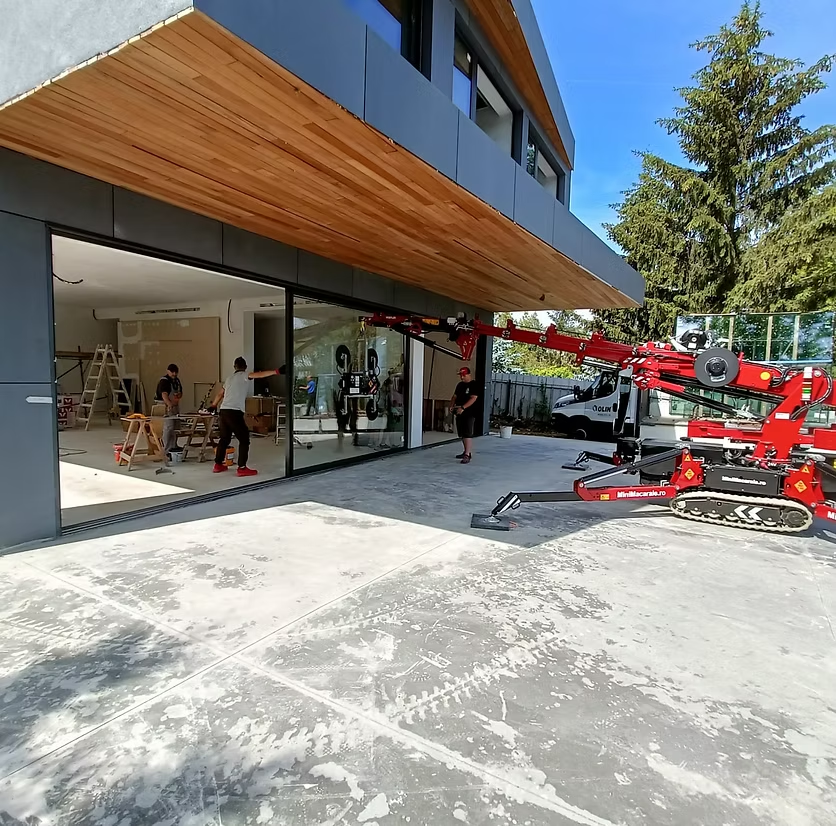

Oversized glass panels 3×4 m, tempered commercial shopfronts, panoramic facades for showrooms and retail spaces — installation with specialised equipment across Bucharest and Ilfov. Complete guide: glass types, maximum dimensions, burglar resistance classes and indicative prices 2026.
What oversized glass is and who needs it
The term "oversized" describes any glass panel whose dimensions exceed standard transport and handling limits — in practice, any sheet larger than 2,500 × 3,500 mm or heavier than 150 kg per panel.
These sizes are regularly required by:
- Car showrooms and dealerships — panoramic display windows 3–5 m wide with no visible vertical joint
- Premium retail stores — glass facades for maximum visibility from the street
- Restaurants and cafés — glass walls that erase the boundary between inside and outside
- Office buildings and corporate headquarters — curtain wall facades with large panels for visual identity
- Hotels — glazed lobbies, panoramic walls at pools and conference rooms
- Premium residential — villas with floor-to-ceiling windows or sliding doors with a single panel over 3 m
Glass types for large display windows and panels
1. Toughened glass (thermally tempered)
Thermal tempering at 620–680 °C followed by rapid cooling increases the strength of the glass four to five times over ordinary float glass. On breakage it shatters into small granules with no sharp edges — essential for safety in public spaces.
Specifications for commercial display windows:
- Standard thicknesses: 8 mm, 10 mm, 12 mm, 15 mm, 19 mm
- Maximum toughened sheet size: 3,500 × 8,000 mm
- Recommended thickness for a ground-floor commercial window: 10–12 mm
- Thickness for a frameless structural facade: 15–19 mm
2. Laminated glass (VSG — Verbund-Sicherheitsglas)
Two or more sheets of glass bonded with interlayers of PVB or SGP. On impact the glass stays in the frame — the fragments adhere to the interlayer. The standard for anti-burglary and bullet-resistant applications.
Resistance classes to EN 356:
- P2A — withstands 3 hammer blows → standard shop window
- P4A — withstands 9 hammer blows → jewellers, pharmacies
- P6B — withstands an axe → banks, currency exchange offices
- FB4/FB6 — bullet resistant → special applications
Burglary resistance classes to EN 1627:
- RC2 — resists 3 minutes against a screwdriver → retail standard
- RC3 — resists 5 minutes against a crowbar → jewellers, night pharmacies
- RC4 — resists 10 minutes against a drill → banks, vaults
3. Large-format insulating glass
Oversized insulating glazing combines thermal performance with large dimensions. The technical challenge: the perimeter spacer and the sealing gaskets have to stay tight along the full length of a panel over 3 m.
Recommended build-ups for large display windows:
- 4+16+4 with argon: Ug = 1.0 W/m²K — commercial standard
- 6+16+6 with argon and Low-E: Ug = 0.6 W/m²K — showroom with energy requirements
- 8+16+8 toughened with Low-E: strength plus insulation for premium retail
Warm Edge spacers are mandatory on large panels, to eliminate condensation at the corners and avoid perimeter thermal bridges.
4. Reflective and screen-printed glass for facades
Reflective glass (metallic coating on face 2) reduces the solar factor g to 0.15–0.30 and gives a mirror appearance from outside. The standard choice for car showrooms and commercial facades facing south or west.
Screen-printed glass: ceramic ink fired at 620 °C into the body of the glass — permanent and UV resistant. It allows branding on the shopfront, partial privacy effects or purely architectural detail.
Maximum available dimensions — what we can deliver
| Glass type | Thickness | Maximum size | Maximum weight |
|---|---|---|---|
| Toughened float | 8–19 mm | 3,500 × 8,000 mm | 1,500 kg |
| Laminated VSG | 8+8 – 12+12 | 3,300 × 6,000 mm | 900 kg |
| Standard insulating unit | 4+16+4 | 3,000 × 4,000 mm | 120 kg |
| Toughened insulating unit | 6+16+6 | 3,000 × 5,000 mm | 350 kg |
| Toughened reflective | 6–12 mm | 3,200 × 6,000 mm | 600 kg |
*Dimensions depend on the specific build-up and on transport capacity. Contact us for confirmation on your project.*
Fixing systems for frameless display windows
Spider fitting (point fixing)
The most elegant solution for commercial shopfronts — the glass is held by stainless steel point bolts, with no visible perimeter frame. The visual result is a continuous glass surface.
- Standard spacing between points: 1,000–1,500 mm
- Minimum glass size: 1,000 × 1,000 mm
- Minimum glass thickness: 12 mm toughened or 8+8 laminated
- The glass must be drilled before tempering — drilling after toughening is impossible
Minimal aluminium profile (slot system)
An aluminium profile with a 10 mm slot into which the glass is inserted directly. Visually: a thin aluminium line at the perimeter, with the glass in the foreground.
SG system (structural silicone)
The glass is bonded with structural silicone onto a concealed metal frame. No visible profiles at all. Used in semi-structural and structural curtain walls.
Indicative prices for large glass panels — 2026
> ⚠️ Important note: these prices are indicative and reflect conditions as at March 2026. Glass prices vary considerably with availability and exchange rates. Always ask for an up-to-date quotation.
| Product | Size | Indicative price |
|---|---|---|
| Toughened glass 10 mm | 2,000 × 3,000 mm | 450–700 EUR |
| Toughened glass 12 mm | 2,500 × 3,500 mm | 700–1,100 EUR |
| Laminated VSG 8+8 P2A | 2,000 × 3,000 mm | 600–900 EUR |
| Laminated VSG RC2 | 2,000 × 3,000 mm | 900–1,400 EUR |
| Toughened insulating unit 6+16+6 | 2,500 × 3,000 mm | 800–1,300 EUR |
| Stainless spider fitting (per point) | — | 80–180 EUR |
| Complete installation (robot plus labour) | per panel | 350–800 EUR |
*Prices exclude specialised transport and any preparatory work on the supporting structure.*
Why Neofort BIZ for large glass panels
Installing oversized glass cannot be done by conventional means. Neofort BIZ has specialised vacuum-cup handling equipment with a capacity of up to 1,400 kg and works with certified teams for installation at height and in confined spaces. All the details in the complete guide to aluminium systems.
WhatsApp: +40 752 443 435 | Mon–Fri 10–18
Frequently asked questions
From what size is glass considered oversized?
"Oversized" describes any glass panel that exceeds standard transport limits — in practice, any sheet larger than 2,500 × 3,500 mm or heavier than 150 kg. Such panels are required by car showrooms, premium retail, restaurants, offices, hotels and high-end residential projects with floor-to-ceiling windows.
What type of glass is used for large display windows?
Toughened glass, thermally tempered, is the standard for shopfronts. Tempering at 620–680 °C followed by rapid cooling increases strength four to five times over float glass. On breakage it shatters into small granules with no sharp edges — essential for safety in public spaces.
What are the maximum dimensions of a toughened glass sheet?
A toughened sheet can reach a maximum of 3,500 × 8,000 mm, in standard thicknesses of 8, 10, 12, 15 or 19 mm. These sizes allow panoramic shopfronts 3–5 m wide with no visible vertical joint, ideal for showrooms and retail facades.
Why does toughening matter in public spaces?
When it breaks, toughened glass shatters into small granules with no sharp edges, unlike float glass, which produces dangerous shards. That is essential for safety in showrooms, shops, restaurants and any public space with heavy footfall.
Neofort BIZ carries out aluminium joinery and facade works in Bucharest and Ilfov, from windows and doors to curtain walls. Discover the aluminium windows range or request a quote. All the details in the complete guide to aluminium systems.
Complete technical guide for nZEB windows in Romania 2026: mandatory minimum values, recom…
Read →Technical GuideTriple vs Double Glazing: How Much Do You Really Save on Heating? Real Calculations 2026Is triple glazing worth it vs classic double? Concrete calculations for apartments and hou…
Read →Technical GuidePVC or Aluminium for nZEB Homes in 2026? Complete Guide by Energy Efficiency, Cost and DurabilityPVC or aluminium for your nZEB home? Complete technical guide 2026: real Uw, total cost, d…
Read →