
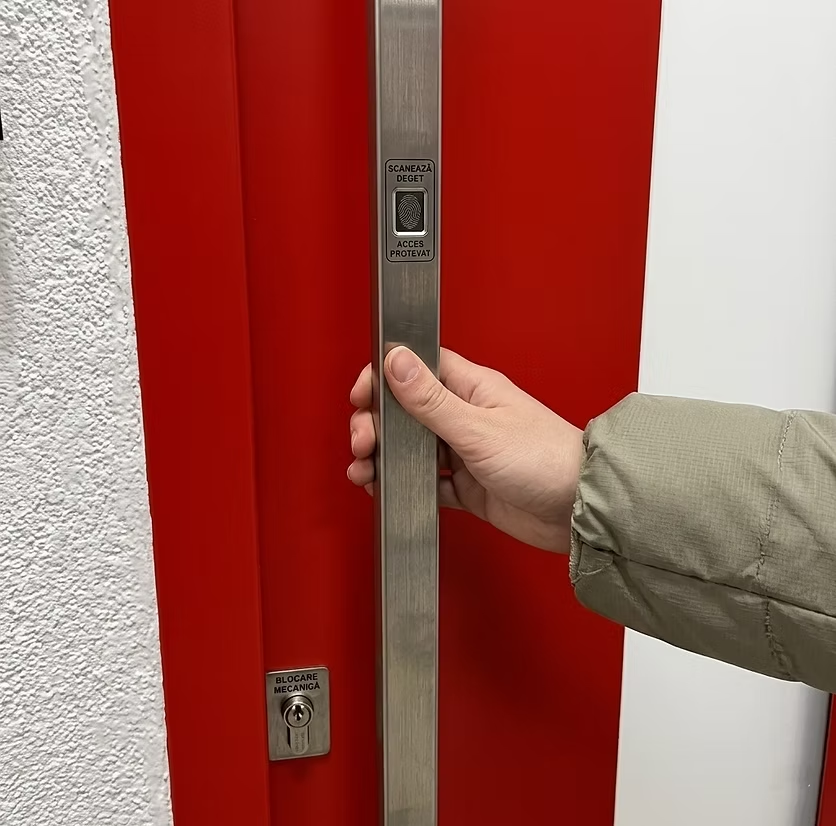

Anti-burglary entry doors with fingerprint control combine certified mechanical protection (RC 3–RC 4) with modern biometric access — no keys, no vulnerable cylinders. Neofort BIZ manufactures and installs aluminium and metal doors with state-of-the-art touch systems for homes in Bucharest and Ilfov.
Why the entrance door is the critical security point of a house
European statistics from the residential security sector consistently show that more than 70% of home burglaries happen through the main or back entrance door — not through windows or other access points. The reason is simple: doors are large openings with a single locking zone (the lock), and often with cylinders that are vulnerable to forcing.
The modern answer combines two layers of protection:
- Mechanical — robust certified construction, resistance classes RC 2–RC 4
- Biometric — access by fingerprint, PIN code or card, which removes the weakness of classic cylinders
Burglary resistance classes — what RC 2, RC 3 and RC 4 mean
The European classification EN 1627 defines six resistance classes (RC 1–RC 6) for doors and windows, based on the time and tools an attacker needs to force the product:
| Class | Resistance time | Attacker tools | Typical application |
|---|---|---|---|
| RC 1 | 3 minutes | Bodily force | Interior, utility doors |
| RC 2 | 3 minutes | Crowbars, screwdrivers | Apartment standard |
| RC 3 | 5 minutes | Chisels, pry bar | Residential villa |
| RC 4 | 10 minutes | Saw, drill | High-risk properties |
| RC 5 | 15 minutes | Power tools | Commercial, institutional |
| RC 6 | 20 minutes | Advanced power tools | Banks, jewellers |
The Neofort BIZ recommendation:
- Houses and villas in Bucharest and Ilfov — RC 3 minimum
- High-risk areas or isolated properties — RC 4
- Apartments — RC 2 is sufficient, RC 3 gives extra comfort
Construction of an aluminium and steel security door — what it must contain
The door leaf structure
A properly built security door has:
- The core — steel plates 1.5–3 mm thick, arranged in multiple layers, filled with basalt wool (thermal and acoustic insulation plus resistance to forcing)
- The frame — steel or extruded aluminium profile, with certified minimum thicknesses
- The external cladding — electrostatically coated aluminium in any RAL colour, toughened glass or laminated timber on request
The multipoint locking system
A lock with a single locking point resists less than a multipoint system, whatever the class of the cylinder. Security doors from RC 3 upwards include:
- At least 5 locking points (bolts and hooks on 3 sides of the leaf)
- Steel bolts Ø14–18 mm — resistant to impact and forcing
- Locking hooks — prevent the leaf from bending under a crowbar attack
- Cylinder protection plates — hardened steel, preventing the cylinder from being pulled out
The frame and its anchoring in the masonry
Even the most robust door system becomes ineffective if the frame is poorly anchored. Neofort BIZ uses:
- A steel frame at least 2 mm thick, in closed profiles
- At least 4 anchors per side — fixed into masonry or concrete with chemical anchors
- EPDM sealing profiles on 3 sides — thermal and acoustic insulation
The fingerprint control system — how it works and what it offers
The biometric sensor
The fingerprint sensor built into the handle or access plate is an optical or capacitive scanner which:
- Scans and digitises the fingerprint in under 0.5 seconds
- Compares it against up to 200 stored fingerprints (authorised users)
- Releases the lock electrically on a match, or displays a rejection code
- Works at temperatures from −20 °C to +65 °C
- Power: AA batteries (6–12 months of autonomy) or a 12 V cable
Available access methods
Modern systems offer several access methods, each configurable independently:
| Method | Security | Convenience |
|---|---|---|
| Fingerprint | ⭐⭐⭐⭐⭐ | ⭐⭐⭐⭐⭐ |
| PIN code | ⭐⭐⭐ | ⭐⭐⭐⭐ |
| RFID / NFC card | ⭐⭐⭐ | ⭐⭐⭐⭐ |
| Bluetooth (smartphone) | ⭐⭐⭐⭐ | ⭐⭐⭐⭐⭐ |
| Mechanical key | ⭐⭐ | ⭐⭐ |
| Combined (2FA) | ⭐⭐⭐⭐⭐ | ⭐⭐⭐ |
Why a fingerprint removes the weakness of a classic key
A classic key has a fundamental security flaw: it can be copied (sometimes without the owner knowing), lost or stolen. A door cylinder can be forced by bumping or picking in seconds by an experienced attacker, regardless of the brand or price of the cylinder.
A fingerprint removes those weaknesses entirely:
- It cannot be copied without the finger being physically present
- It cannot be lost or left at home
- Revoking a user’s access takes three seconds from the menu
Integration with smart home systems
Modern biometric access systems integrate with:
- Wi-Fi and Bluetooth protocols — control and monitoring from a mobile app
- Alexa and Google Home — voice commands for locking and unlocking
- Alarm systems — automatic triggering on a break-in attempt
- Video cameras — automatic recording on access or unauthorised attempt
Manufacture and installation at Neofort BIZ
Neofort BIZ manufactures security doors to order, customised for each project:
Customisation options
- Dimensions — any size, including double doors and doors with a transom light
- External material — RAL-coated aluminium, toughened glass, perforated metal panels
- Colours — any RAL colour or wood-effect film
- Glazing — toughened glass, insulating glass, opaque glass (frosted or printed)
- Access systems — fingerprint, PIN, card, Bluetooth, or a combination
The manufacturing and installation process
- Consultation and design — site visit, measurements, proposed solution
- Manufacture — 15–25 working days
- Professional installation — specialist team, 4–8 hours per door
- Warranty certificate — full cover on product and workmanship
- Service — rapid response for adjustments or parts under warranty
See also our aluminium joinery or contact us for a consultation at our offices.
Request a quote: oferte@neofort-biz.ro | +40 752 443 435 | Mon–Fri 10–18
Frequently asked questions
Where do most burglaries in a home take place?
European statistics show that more than 70% of residential burglaries happen through the main or back entrance door — not through windows. The reason: doors are large openings with a single locking zone (the lock) and often cylinders that are vulnerable to forcing.
What do burglary resistance classes RC 2, RC 3 and RC 4 mean?
Under EN 1627, RC 2 resists 3 minutes against crowbars and screwdrivers (apartment standard), RC 3 resists 5 minutes against chisels and a pry bar (residential villas), and RC 4 resists 10 minutes against a saw and a drill (high-risk properties).
Which resistance class is recommended for a villa in Bucharest?
For houses and villas in Bucharest and Ilfov, class RC 3 is the recommended minimum, resisting 5 minutes against chisels and a pry bar. For apartments, the RC 2 standard (3 minutes) is usually sufficient.
How does biometric access remove the weakness of classic cylinders?
Modern security doors combine mechanical protection (RC 2–RC 4 construction) with biometric access — fingerprint, PIN code or card. Biometric access removes the classic cylinder, which is the point most vulnerable to forcing through methods such as bumping or picking.
Neofort BIZ designs and installs Alumil aluminium joinery in Bucharest and Ilfov, with thermal break and its own installation teams. See the aluminium joinery we offer or request a quote. All the details in the complete guide to aluminium systems.
Is triple glazing worth it vs classic double? Concrete calculations for apartments and hou…
Read →Technical GuidePVC or Aluminium for nZEB Homes in 2026? Complete Guide by Energy Efficiency, Cost and DurabilityPVC or aluminium for your nZEB home? Complete technical guide 2026: real Uw, total cost, d…
Read →Technical GuideHow Can I Improve Window Thermal Insulation in Bucharest? Complete Guide 2026Feeling heat loss through your windows in Bucharest? Complete guide 2026: how to improve t…
Read →