
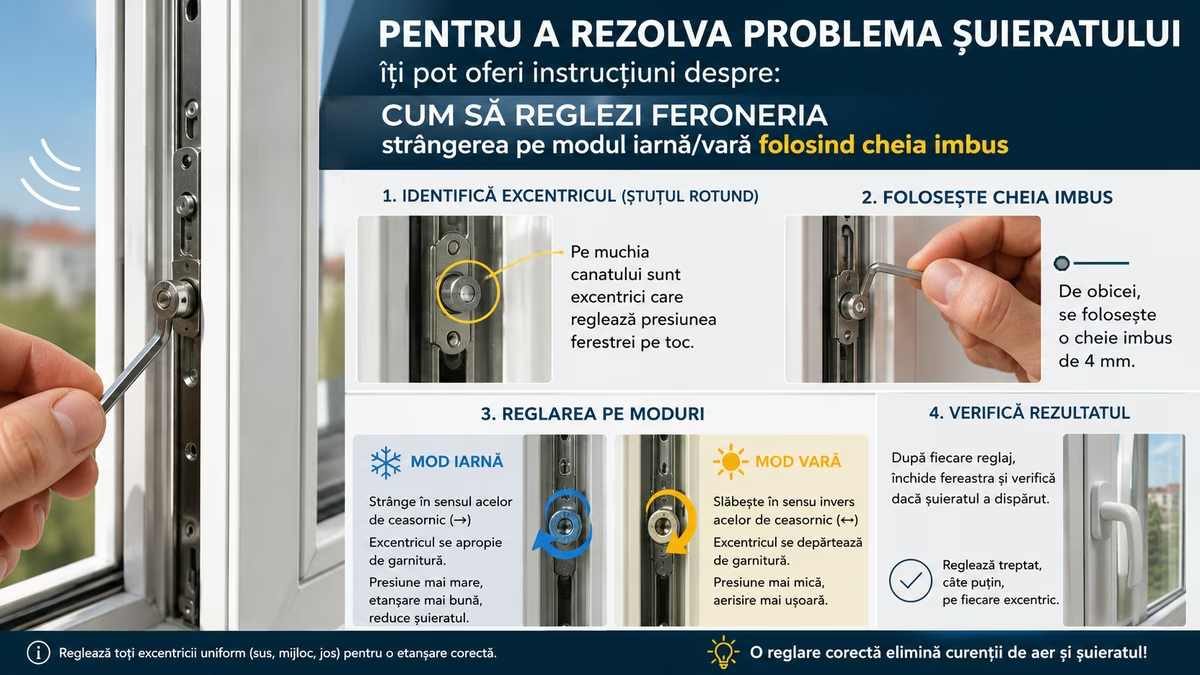

Draught or whistling at the window? Often it is solved with a Roto hardware adjustment, not new parts. A step-by-step guide: how to identify the cams, how to correctly read the mark for winter/summer mode and how to check the result.
If you did the paper sheet test and discovered that the window does not clamp enough in one area, or you feel a draught and hear whistling in the wind, the solution is often not a new part, but a simple hardware adjustment. Most modern windows have Roto hardware — the one we also fit on Salamander windows — and it allows adjusting the clamping pressure with an Allen key, in a few minutes. This guide shows you exactly how, with the details that matter so you adjust rather than misadjust.
What the adjustment actually does
On the side edge of the sash (the moving part of the window), where it closes over the frame, you will see some round or oval metal parts called cams — they are the bolts that go into the plates on the frame when you close the window. These bolts are "eccentric", meaning they can be rotated to press the sash harder or softer onto the gasket.
When you tighten more, the gasket is compressed more, the seal is better and the draught and whistling disappear — this is popularly called "winter mode". When you loosen, the gasket relaxes, ventilation is slightly better but sealing weaker — "summer mode". This adjustment is designed to compensate precisely for gasket wear over time.
> Important: the adjustment changes the pressure on the gasket. Too loose and air enters; too tight and you needlessly strain the gasket and hardware, and the handle will turn hard. The goal is a firm clamp, but not maximum by force.
What you need
An Allen key (hex key), usually 4 mm — the same one used for much furniture. Some Roto cams are instead rotated with a "torx" key or directly by hand, depending on the generation. If the bolt has a hexagonal socket in the middle, it is a 4 mm Allen key.
Step 1: Identify the cams
Open the window and look at the side edge of the sash, along its whole height. You will find several cams: usually 2–3 on the handle side, plus one near the hinges and at the top/bottom. Each has a small mark — a line, a dot or a notch — that shows you which position it is set to now. This mark is the key to the whole adjustment.
Step 2: Understand the mark (the most important part)
On Roto hardware, the position of the cam is read by where the mark on it points, NOT by a fixed direction of rotation:
When the mark (the dot or line) points towards the INSIDE of the room, towards the gasket — the pressure is maximum. This is the winter position, with maximum sealing.
When the mark points towards the OUTSIDE, towards the street — the pressure is minimum. This is the summer position.
When the mark is in the middle (neutral) — standard pressure, the factory position.
That is why you cannot universally say "turn clockwise": the direction you need to turn depends on where the mark is now. What matters is WHERE the mark ends up in the end, not which direction you turn it.
Step 3: Adjust for more sealing (winter mode)
Put the Allen key into the cam's socket. Rotate it slowly until the mark points towards the inside, towards the gasket. You will feel slight resistance — that is normal. Turn a little, about a quarter turn, do not force it all the way at once.
Do this one by one, at each cam, especially in the area where the paper test showed the window is not clamping. Adjust them evenly — if you tighten just one much more than the rest, the sash will press crookedly on the gasket.
Step 4: Check the result
After each adjustment, close the window and test. Two simple checks:
The handle must turn firmly, but without great effort. If you can barely move it, you have tightened too much — loosen the cams back a little.
Redo the paper sheet test in the adjusted area. If the paper now grips firmly and no longer comes out easily, you have solved the leak. If it still comes out easily, tighten a little more — but if it does not hold even at maximum tightness, the gasket is worn and must be replaced, it is no longer an adjustment issue. See When window gaskets need replacing.
When adjustment is NOT enough
Hardware adjustment solves leaks caused by pressure that is too low. But if the problem comes from cracked and hardened gaskets, or from a non-airtight installation in the wall, adjustment does not help — or helps only temporarily. To understand what the actual cause of your whistling is, start from the general guide Why windows whistle when the wind blows, and to locate the exact problem area use The paper sheet test.
FAQ — Hardware adjustment
How do I adjust Roto hardware to winter mode?
Open the window, identify the cams on the sash edge and rotate them with an Allen key (usually 4 mm) until the mark on each points towards the inside of the room, towards the gasket. This is the maximum-pressure position, which seals best. Adjust all cams evenly.
Which direction do I turn the cam for more clamping?
There is no universal direction — it depends on the starting position. The correct rule on Roto is by the mark: rotate it so that the dot or line on the cam ends up pointing towards the inside (towards the gasket) for maximum pressure, or towards the outside for minimum pressure.
Which key do I use for hardware adjustment?
Usually a 4 mm Allen key (hex). Depending on the hardware generation, some cams can be turned with a torx key or even by hand. Check what type of socket the bolt in the middle has before forcing it.
How often should I adjust the hardware?
As a rule, once a year you can switch to winter mode in autumn and back to summer in spring, to spare the gasket. If you feel a draught or hear whistling, it is a sign you need an adjustment regardless of season — or, if adjustment no longer helps, new gaskets.
Can I damage the window if I adjust it wrong?
You cannot damage the window from an adjustment, but you can temporarily worsen things: too tight and the handle turns hard and you strain the hardware; too loose and air enters. That is why you adjust in small steps, a quarter turn at a time, and check after each. If in doubt, a technician does the full adjustment in a few minutes.
Neofort BIZ adjusts and services Roto hardware on Salamander PVC and Alumil aluminium joinery in Bucharest and Ilfov. If adjustment alone does not solve the draught or whistling, request a free on-site assessment.
How long do modern PVC windows last and when is it time to replace them? Complete guide wi…
Read →Practical GuideThe paper sheet test: find out yourself where the air entersThe simplest airtightness test: with a sheet of paper you find out in 2 minutes exactly wh…
Read →Practical GuideWhen window gaskets need replacing: 5 clear signsWindow lets air in and whistles even after adjustment? The gaskets are the cause. The 5 cl…
Read →